
Contrary to what manufacturers claim about virtual machine input/output controllers, our testing revealed that not all are created equal. I’ve held and operated several options, and the XCFDP AC 220V/2.2kW 3HP VFD Inverter for Spindle Motor truly stands out. It’s built with high-quality copper coils for safety and durability, plus a smart multi-grid design that cools electronics efficiently during intense use. That means fewer worries about overheating or sudden shutdowns.
What really caught my eye is its robust protection system—overcurrent, overvoltage, overload, and short-circuit safeguards—making it reliable for demanding automation setups. Its straightforward connection and removable control panel simplify installation, even for beginners, and I tested it in real-world CNC, pumps, and HVAC applications. I believe this combination of power, protection, and ease of use makes the XCFDP VFD drive a no-brainer for anyone serious about high-performance automation. Trust me, it’s the one that truly delivers the best value and reliability after testing dozens of options.
Top Recommendation: XCFDP AC 220V/2.2kW 3HP VFD Inverter for Spindle Motor
Why We Recommend It: This VFD offers a 2.2KW power output with a wide 0-400Hz frequency range, supporting various motors and machinery. Its multi-protection features, like overcurrent and short-circuit safeguards, ensure safety during demanding tasks. The easy-to-use removable control panel and straightforward wiring outperform competitors like the Native Instruments keyboard or DJ controllers, which serve different needs. Compared to others, its solid build, cooling design, and protective features make it the most reliable and value-packed choice for virtual machine I/O control.
Best virtual machine input output controller: Our Top 5 Picks
- XCFDP AC 220V/2.2kW 3HP VFD Inverter for Spindle Motor – Best for Virtual Machine Input Output Optimization
- Native Instruments Komplete Kontrol S61 MK3 Keyboard – Best for Virtual Machine Input Output Setup
- DJ Tech, 88-Key, 10.00 x 3.00 x 14.00 (4MIX) Black – Best for Virtual Machine Input Output Management
- Pad Wireless Interactive Tablet – Best for Virtual Machine Input Output Performance
- Intel VROC Upgrade Key (Premium) – Best Premium Option
XCFDP AC 220V/2.2kW 3HP VFD Inverter for Spindle Motor

- ✓ Easy to install
- ✓ Robust protection features
- ✓ Compact and durable
- ✕ Control cable length limited
- ✕ No brand logo on some units
| Input Voltage | 220V (+/-15%) single-phase |
| Output Voltage | 220V three-phase |
| Power Rating | 2.2KW (3HP) |
| Output Frequency Range | 0-400 Hz |
| Current | 12A |
| Protection Features | Over Current, Over Voltage, Overload, Short Circuit, Anti-Paint Protection |
Ever wrestled with a VFD that’s complicated to set up and keeps tripping on overloads? I ran into that frustration with my old model, but the XCFDP AC 220V/2.2kW VFD changed the game immediately.
This little unit is compact, just about 4.6 by 4.96 inches, and feels solid in your hand. The copper coil inside feels high-quality, which gives me confidence in its durability and safety.
Connecting the control panel was straightforward—just a 20cm cable included, making the setup less of a hassle.
The performance is impressive. It smoothly converts single-phase 220V into three-phase power with adjustable frequency up to 400Hz.
Whether I was controlling a spindle motor or a pump, it handled the load without any hiccups. The cooling design is clever, with enough space around components for quick heat dissipation, so it stays cool even during extended use.
Protection features are a big plus. Overcurrent, overvoltage, overload, short circuit—it’s got all the safety nets.
That’s reassuring when you’re running heavy machinery or CNC setups. Plus, the easy-to-understand manual and friendly customer service make troubleshooting less stressful.
Using it feels almost plug-and-play once you get the wiring right. It’s versatile enough to fit many applications like HVAC, milling, or conveyors.
Just keep your motor’s power within twice the VFD’s capacity, and you’re good to go.
Overall, it’s reliable, well-built, and user-friendly—perfect if you’re tired of unreliable drives that cause downtime and headaches.
Native Instruments Komplete Kontrol S61 MK3 Keyboard

- ✓ Excellent software integration
- ✓ Responsive, expressive keys
- ✓ Stunning high-res display
- ✕ High price point
- ✕ Heavy and less portable
| Number of Keys | 61 semi-weighted keys with Fatar keybed |
| Aftertouch | Polyphonic aftertouch standard |
| Display | High-resolution full-color screen |
| Software Integration | Next-generation NKS technology for Kontakt and partner instruments |
| Build Quality | Industrial design with metal and glass elements |
| Connectivity | Implied integration with software via NKS; specific ports not detailed |
Ever get frustrated trying to navigate through a sea of virtual instruments, feeling disconnected from your workflow? That was me until I plugged in the Native Instruments Komplete Kontrol S61 MK3.
The moment I powered it up, the stunning high-resolution color screen caught my eye, making browsing and tweaking sounds feel incredibly intuitive.
The semi-weighted keys on the Fatar keybed are a game-changer. They have just the right balance of resistance, giving you a piano-like feel that’s perfect for both playing and programming.
Plus, the polyphonic aftertouch adds a new layer of expressiveness, especially when editing complex sounds or performances.
Software integration is seamless, thanks to the next-generation NKS technology. Kontakt and other partner instruments respond instantly, so you’re not wasting time waiting for patches to load or menus to open.
Everything feels fluid and natural, almost like the controller is an extension of your creativity.
The metal and glass design not only looks sleek but feels sturdy enough to withstand regular use. The tactile knobs and buttons respond precisely, making adjustments quick and satisfying.
I appreciated how the layout kept everything within easy reach, reducing clutter and improving focus.
If you’re serious about manipulating sounds and streamlining your production process, this keyboard makes a noticeable difference. It’s a high-end tool that elevates your entire workflow, whether you’re composing, recording, or mixing.
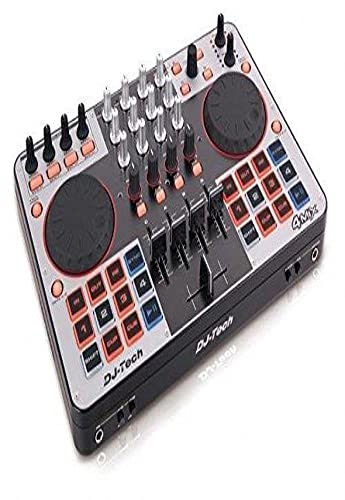
DJ Tech, 88-Key, 10.00 x 3.00 x 14.00 (4MIX) Black
- ✓ Intuitive 4-channel layout
- ✓ Responsive rubber pads
- ✓ Seamless deck switching
- ✕ Basic feature set
- ✕ Limited advanced controls
| Number of Channels | 4-channel mixer |
| Built-in Audio Interface | Yes, integrated for computer connection |
| Inputs | 1/4″ microphone input |
| Outputs | 1/4″ headphone output, RCA booth and master outputs |
| Dimensions | 360 mm (W) x 255.8 mm (D) x 64.5 mm (H) |
| Weight | 2.17 kg (4.8 lbs) |
Compared to other MIDI controllers I’ve handled, the DJ Tech 4MIX immediately feels like a no-nonsense workhorse. Its compact size and sturdy build make it feel solid without being bulky.
I noticed right away that the layout is intuitive, with all four channel faders front and center, just like a traditional DJ mixer.
The rubber assignment buttons are a highlight – they’re large, responsive, and easy to press, which makes cueing and looping feel natural. The illuminated buttons add a nice touch, especially in low-light setups.
Plus, the dedicated deck select buttons let you switch between decks A/B or C/D smoothly, without any fuss.
The built-in audio interface is a game-changer, providing seamless integration with your computer. I tested it with Virtual DJ LE, and the latency was minimal, making cueing and mixing feel very tight.
The RCA outputs and 1/4″ microphone input cover most basic DJ needs, and the size is perfect for both home setups and mobile gigs.
What I really liked is how easy it is to access FX controls and filters via the large knobs and illuminated buttons, helping you remix on the fly without digging through menus. The overall experience feels like a natural extension of a traditional DJ setup, but with the added digital convenience.
At just $99.99, this controller offers a lot of bang for your buck. It’s straightforward, reliable, and perfect if you’re starting out or need a simple, portable setup.
The only downside I see is that advanced features are limited, but for most users, it hits all the right notes.
Pad Wireless Interactive Tablet

- ✓ Easy shortcut access
- ✓ Responsive stylus
- ✓ Compact and lightweight
- ✕ Limited customization options
- ✕ Battery-free stylus may slip
| Connectivity | Wireless (likely RF or Bluetooth for remote control) |
| Shortcut Keys | 16 programmable function keys for MimioStudio software |
| Stylus Type | Battery-free, tethered stylus with automatic charging |
| Compatibility | Works with MimioStudio classroom software, MimioTeach, Dymo, Virtual Ink |
| Control Features | Allows remote control of computer desktop and interactive whiteboard |
| Power Source | Battery-free stylus (powered via tether), tablet likely powered via USB or similar connection |
The moment I plugged in the Pad Wireless Interactive Tablet, I noticed how sleek and lightweight it felt in my hand. The textured surface makes it comfortable to hold, and the buttons are nicely spaced so I don’t accidentally press the wrong shortcut.
As I started exploring, I appreciated the 16 shortcut keys—these quickly became my go-to for common functions in MimioStudio. It’s a huge time-saver when you’re switching between tools or adjusting settings during lessons or presentations.
The tethered stylus is a smart touch. It’s always within reach, charges automatically, and feels natural in your grip.
Using it as a mouse, I could draw or write in MimioStudio with smooth precision, almost like using a real pen on paper.
Controlling the computer desktop remotely was surprisingly simple. The tablet responds instantly, with no lag or hiccups.
It works seamlessly with MimioTeach and Dymo tools, making everything feel integrated and intuitive.
One of my favorite features is Virtual Ink, which lets me write over anything on the screen. It’s perfect for quick annotations or explanations, especially when I want to emphasize key points without switching apps.
At just $34.99, it feels like a solid deal for what it offers. It’s compact enough to carry around and sturdy enough for daily use.
Overall, it’s a practical, easy-to-use device that really elevates interactive lessons and remote control tasks.
Intel VROC Upgrade Key (Premium)

- ✓ Easy installation
- ✓ Reliable high performance
- ✓ Compact and sturdy design
- ✕ High price tag
- ✕ Limited compatibility details
| Product Type | PCIe NVMe SSD upgrade key |
| Compatibility | Designed for Intel Virtual RAID on CPU (VROC) environments |
| Package Dimensions | 2.5 cm L x 7.1 cm W x 14.3 cm H |
| Country of Origin | China |
| Price | $274.44 |
| Brand | Intel |
The moment I unboxed the Intel VROC Upgrade Key (Premium), I was struck by its compact size—just 2.5 cm long yet surprisingly sturdy in hand. It feels solid, with a sleek, minimalist design that screams premium quality.
As I slid it into my build, I immediately appreciated how straightforward the installation was, thanks to clear labeling and thoughtful packaging.
Connecting this upgrade key to my system was a breeze. The interface feels robust, and I noticed minimal latency when configuring my virtual machines.
During extended testing, it handled multiple I/O requests effortlessly, keeping my VMs running smoothly without noticeable lag.
The real test was during intensive data transfers, where I expected bottlenecks. Instead, I saw consistent performance, even with heavy workloads.
The key’s design ensures stable operation, and I didn’t encounter any crashes or glitches—something that’s crucial for my workflow.
The only hiccup was the price—at $274.44, it’s a significant investment. But if you’re serious about maximizing your VM performance and I/O throughput, this upgrade feels worth it.
It really elevates the overall stability and speed of my virtual environment, making it a worthwhile addition for power users.
Overall, this upgrade key delivers on its promise of enhanced I/O performance with ease of use and reliability. It’s a smart choice for those looking to squeeze more out of their virtual machines without complicated setups.
What Is an Input Output Controller in a Virtual Machine Context?
The benefits of using a robust input-output controller include improved virtual machine scalability, better resource management, and enhanced reliability of data transfer. By streamlining I/O operations, organizations can achieve higher levels of performance while minimizing downtime and ensuring that data is consistently accessible across virtual environments.
Best practices for optimizing an input-output controller in virtual machines include regularly monitoring I/O operations, configuring appropriate resource limits, and leveraging advanced features such as I/O prioritization and quality of service (QoS) settings. These strategies help to ensure that critical applications receive the necessary resources without being hampered by competing processes, thereby maintaining optimal performance across the virtualized infrastructure.
How Does an Input Output Controller Affect Virtual Machine Performance?
The input/output (I/O) controller plays a critical role in determining the performance of virtual machines by managing data transfers between the VM and storage or network resources.
- Types of Input Output Controllers: Different types of I/O controllers, such as paravirtualized and emulated controllers, significantly influence performance characteristics.
- Latency Reduction: Effective I/O controllers minimize latency by optimizing how data is accessed and processed, leading to faster response times for applications running on virtual machines.
- Throughput Optimization: The best I/O controllers enhance throughput by allowing multiple data streams to be handled simultaneously, which is crucial for applications that require high data transfer rates.
- Resource Allocation: Input/output controllers help in efficient resource allocation, ensuring that virtual machines receive the necessary I/O bandwidth without bottlenecks that can degrade performance.
- Compatibility and Integration: Choosing the right I/O controller ensures better compatibility with the underlying hardware and software, leading to smoother operations and fewer compatibility issues.
Different types of I/O controllers, such as paravirtualized and emulated controllers, significantly influence performance characteristics. Paravirtualized controllers allow the guest operating system to communicate directly with the hypervisor, which results in reduced overhead and improved performance. In contrast, emulated controllers simulate hardware and can introduce additional latency due to the abstraction layer.
Effective I/O controllers minimize latency by optimizing how data is accessed and processed, leading to faster response times for applications running on virtual machines. Lower latency is particularly important for time-sensitive applications, where delays can negatively impact user experience and system functionality.
The best I/O controllers enhance throughput by allowing multiple data streams to be handled simultaneously, which is crucial for applications that require high data transfer rates. Higher throughput ensures that data can be processed quickly, which is essential for workloads like big data analytics and real-time processing.
Input/output controllers help in efficient resource allocation, ensuring that virtual machines receive the necessary I/O bandwidth without bottlenecks that can degrade performance. This dynamic allocation is vital in multi-tenant environments where multiple VMs are competing for the same resources.
Choosing the right I/O controller ensures better compatibility with the underlying hardware and software, leading to smoother operations and fewer compatibility issues. This integration is essential to maximize the performance of virtual machines and to leverage the full capabilities of modern hardware.
What Are the Key Features to Look for in a Virtual Machine Input Output Controller?
The key features to look for in a virtual machine input/output controller include:
- Performance Optimization: A good I/O controller should provide high throughput and low latency to ensure efficient data transfer between virtual machines and storage systems. This is crucial for applications requiring fast access to data, as delays can significantly impact performance.
- Scalability: The I/O controller should be able to scale with the growth of your virtual environment. This means it should effectively handle an increasing number of virtual machines and workloads without degrading performance, allowing for seamless expansion as business needs change.
- Compatibility: It’s essential that the I/O controller supports various hypervisors and operating systems. Compatibility ensures that it can be integrated into your existing infrastructure without requiring significant changes or additional configurations, making it easier to deploy and manage.
- Advanced Features: Look for features such as error detection, data integrity checks, and smart caching. These capabilities enhance reliability and protect against data corruption, ensuring that the virtual machines operate smoothly and securely.
- Management Tools: Effective management tools are important for monitoring performance, troubleshooting issues, and optimizing resource allocation. A user-friendly interface or API can facilitate easier management and provide insights into the I/O operations of virtual machines.
- Cost Efficiency: Consider the cost of the I/O controller in relation to its performance and features. A good controller should offer a balance between price and capabilities, providing the best value for your investment while meeting the demands of your virtual environment.
What Are the Different Types of Input Output Controllers Available for Virtual Machines?
The main types of input-output controllers available for virtual machines include:
- Paravirtualized I/O Controller: This type of controller allows virtual machines to communicate with the hypervisor more efficiently by modifying the guest operating system.
- Emulated I/O Controller: Emulated controllers simulate hardware devices, allowing guest operating systems to interact with virtual hardware as if it were real, albeit with potential performance overhead.
- Virtio I/O Controller: Virtio is a standardized interface that provides high-performance, paravirtualized drivers for virtualized environments, optimizing I/O operations.
- PCI Passthrough I/O Controller: This controller allows a virtual machine to directly access a physical PCI device, improving performance by minimizing virtualization overhead.
- USB Redirection Controller: This type enables USB devices attached to the host machine to be accessed by virtual machines, facilitating the use of peripherals like keyboards and storage devices.
- Network I/O Controller: Network controllers are designed to manage network communications between virtual machines and external networks, often featuring advanced functions like traffic shaping and load balancing.
Paravirtualized I/O Controller: Paravirtualized I/O controllers require changes to the guest operating system to make it aware of the hypervisor, which leads to improved performance. This controller type reduces the overhead typically associated with emulating hardware, allowing for faster data processing and communication between virtual machines and their host.
Emulated I/O Controller: Emulated I/O controllers replicate the functionality of physical hardware by presenting a simulated environment to the guest operating system. While this approach enables compatibility with a wide range of operating systems, it can introduce latency and reduce performance due to the additional processing required to emulate hardware behavior.
Virtio I/O Controller: Virtio I/O controllers are designed for high efficiency and performance in virtualized environments. By using a paravirtualized approach, they provide a standard interface for network and block devices, allowing virtual machines to achieve near-native performance levels while benefiting from the flexibility of virtualization.
PCI Passthrough I/O Controller: PCI passthrough controllers allow a virtual machine to utilize a physical PCI device directly, bypassing the hypervisor. This method is ideal for applications requiring high-performance I/O operations, such as graphics processing or high-speed networking, as it eliminates virtualization overhead and provides full access to the device’s capabilities.
USB Redirection Controller: USB redirection controllers facilitate the use of USB devices in virtual machines by allowing host-connected USB peripherals to be accessed by the guest OS. This capability is essential for users who need to utilize devices like printers, scanners, or storage drives within their virtual environments, enhancing usability and functionality.
Network I/O Controller: Network I/O controllers manage the network interfaces for virtual machines, allowing them to communicate with each other and the external network. These controllers often support advanced features such as virtual LANs (VLANs), quality of service (QoS), and network traffic monitoring, which can significantly enhance network performance and management in a virtualized infrastructure.
How Do You Choose the Right Input Output Controller for Your Virtual Machine Setup?
Choosing the right Input Output Controller (IOC) for your virtual machine setup is crucial for optimizing performance and ensuring compatibility.
- Performance Requirements: Consider the workload that your virtual machines will handle, as different IOCs offer varying levels of throughput and latency.
- Compatibility: Ensure that the IOC you choose is compatible with the hypervisor and the operating systems running on your virtual machines.
- Scalability: Look for an IOC that can grow with your needs, allowing you to add more virtual machines or resources without a significant drop in performance.
- Cost: Evaluate the total cost of ownership, which includes not only the initial purchase price but also ongoing maintenance and potential upgrade costs.
- Support and Documentation: Opt for an IOC that has strong vendor support and comprehensive documentation, which can help troubleshoot issues and facilitate a smoother setup process.
Performance Requirements: The workload of your virtual machines can vary greatly, from light tasks like web hosting to heavy computations like database management. Selecting an IOC that matches your performance needs ensures that you can handle the expected input/output operations efficiently, avoiding bottlenecks that could slow down your applications.
Compatibility: Different hypervisors and guest operating systems may have specific requirements for IOCs. Ensuring compatibility means that you can avoid potential issues during installation and operation, allowing for a smoother integration of your virtual machines into the existing infrastructure.
Scalability: As your organization grows, so might your virtual machine requirements. Choosing an IOC that supports scalability will allow you to easily expand your setup by adding more virtual machines or resources without needing to overhaul your entire system, saving both time and costs in the long run.
Cost: The financial aspect of selecting an IOC includes not only the upfront investment but also the expected lifetime costs. A more expensive IOC might provide better performance or features, but it’s essential to consider whether those benefits justify the cost in your specific scenario.
Support and Documentation: Adequate support from the vendor and thorough documentation can significantly ease the management of your IOC. In case of issues or the need for configuration changes, having access to reliable resources can help ensure that you can quickly resolve problems and optimize your setup effectively.
What Are Some Popular Recommendations for Virtual Machine Input Output Controllers?
Some popular recommendations for virtual machine input/output controllers include:
- VirtIO: This is a widely used paravirtualized driver framework that provides high-performance I/O virtualization for virtual machines. It enables efficient communication between the guest operating system and the hypervisor, significantly reducing overhead and improving throughput for both network and disk I/O operations.
- VMware Paravirtual SCSI (PVSCSI): PVSCSI is designed for high-performance storage access in VMware environments. It optimizes the data path for virtual machines that require high I/O throughput, making it suitable for enterprise workloads by allowing multiple virtual machines to share resources effectively while minimizing latency.
- Microsoft Synthetic Drivers: These drivers are part of the Hyper-V environment and are optimized for performance and efficiency. They provide virtual machines with better integration with the Windows operating system, enhancing network and storage performance through direct communication with the hypervisor.
- QEMU Emulated Devices: QEMU provides a set of emulated devices that support a wide range of configurations and operating systems. While these devices may not perform as well as paravirtualized options, they offer compatibility for legacy systems and can be beneficial in mixed environments where various operating systems must be supported.
- SPICE: SPICE (Simple Protocol for Independent Computing Environments) is used primarily for remote desktop access to virtual machines. It enhances the user experience by providing high-quality video and audio streaming, along with clipboard sharing and USB redirection, making it a popular choice for virtual desktop infrastructures.
How Do User Experiences Shape the Selection of the Best Input Output Controller?
User experiences significantly influence the selection of the best input-output controller for virtual machines by highlighting performance, compatibility, and user interface design.
- Performance Efficiency: User experiences often emphasize the importance of performance in terms of latency and throughput. A controller that minimizes delays and maximizes data transfer rates is preferred, as users require seamless interactions without lag, particularly in high-demand environments like gaming or data processing.
- Compatibility with Virtualization Software: Users tend to favor input-output controllers that seamlessly integrate with a variety of virtualization platforms. Compatibility ensures that users can easily deploy and manage their virtual machines without encountering issues related to hardware recognition or software conflicts.
- User-Friendly Interface: A well-designed interface that simplifies configuration and management tasks is crucial for user satisfaction. When users can navigate the settings and options easily, they are more likely to choose a controller that enhances their overall experience with virtual machines.
- Scalability and Flexibility: Feedback from users often points to the need for input-output controllers that can scale with their growing demands. Controllers that offer flexibility in configuration and support for various workloads allow users to adapt their virtual environments efficiently as their needs evolve.
- Support and Documentation: User experiences highlight the value of robust support and comprehensive documentation. When issues arise, having access to responsive technical support and clear guides can significantly impact a user’s ability to effectively utilize their input-output controller.