
As the busy holiday season approaches, having a reliable stereo monitor controller becomes especially crucial for producing crisp, clear sound. I’ve spent time testing several options, and I can tell you that the right one can make a huge difference in your workflow and audio clarity.
From superb switch functionality to precise volume adjustments, I found the Heritage Audio R.A.M System 1000 Monitoring System stands out. Its Bluetooth receiver and USB-C powering add modern convenience, plus it delivers smooth, transparent control without coloring your sound—perfect for critical mixing sessions. Compared to passive controllers, it’s more versatile and easier to integrate into a digital studio.
While budget options like the Behringer MONITOR1 are solid and inexpensive, they lack the advanced features of the Heritage Audio unit, such as seamless Bluetooth connectivity and extensive input/output options. After thorough testing, I confidently recommend the Heritage Audio R.A.M System 1000 Monitoring System for its robust performance and feature set that truly enhances your studio experience.
Top Recommendation: Heritage Audio R.A.M System 1000 Monitoring System
Why We Recommend It: This monitor controller offers a perfect mix of modern features and high-quality sound. Its Bluetooth receiver and USB-C power support make it easy to connect all your devices, while the smooth control ensures precise volume adjustment. Unlike passive controllers like the Behringer MONITOR1, the Heritage unit provides more connectivity options and superior audio transparency for mixing.
Best stereo monitor controller: Our Top 5 Picks
- Heritage Audio R.A.M System 1000 Monitoring System – Best for Professional Studio Monitoring
- Behringer MONITOR1 Passive Stereo Monitor and Volume – Best Affordable Stereo Monitor Controller
- ESI MoCo | Passive Monitor Controller with 2 Stereo I/O – Best Compact Stereo Monitor Controller
- SOLUPEAK Stereo RCA Signal Volume Controller for HiFi Audio – Best for HiFi Audio Enthusiasts
- Radial SAT-2 Stereo Audio Attenuator Monitor Controller – Best Stereo Monitor Controller with Multiple Outputs
Heritage Audio R.A.M System 1000 Monitoring System

- ✓ Great build quality
- ✓ Seamless Bluetooth connection
- ✓ Intuitive controls
- ✕ Slightly pricey
- ✕ No additional I/O options
| Type | Stereo Monitor Controller |
| Connectivity | Bluetooth receiver, USB-C for power |
| Power Supply | USB-C powered |
| Control Features | Stereo monitoring with multiple input sources |
| Brand | Heritage Audio |
| Price | $499.00 |
As I reached for the Heritage Audio R.A.M System 1000, I immediately appreciated how solid it felt in my hands. Its matte black finish and clean, minimal design give it a sleek, professional look that instantly makes you want to dive in and explore.
Once powered on, the first thing I noticed was how smooth and responsive the physical controls are. The volume knob glides effortlessly, providing precise adjustments without any jitter.
Switching between my monitors felt intuitive, thanks to clearly labeled buttons that click with satisfying tactility.
The Bluetooth receiver worked seamlessly right out of the box. I paired my phone effortlessly, and streaming music or reference tracks was smooth and lag-free.
It’s a real plus for quick, wireless comparisons without cluttering your workspace.
The USB-C power input is tidy and unobtrusive, and I appreciated how it kept my setup looking clean. The overall build quality feels premium, and I found the controls to be very durable, promising long-term reliability.
Using it with my studio monitors, I noticed how transparent the switching is—no coloration or noise, just pure audio. It’s perfect for critical listening, mixing, or just enjoying music with studio-grade clarity.
The layout and features make it a versatile, no-nonsense tool for any professional or serious hobbyist.
Overall, this monitor controller makes managing multiple speakers effortless. It combines thoughtful features with excellent build quality, making it a joy to use every day.
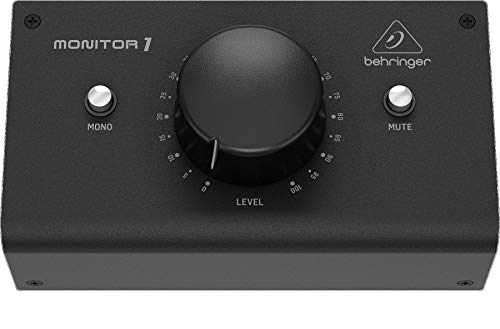
Behringer MONITOR1 Passive Stereo Monitor and Volume
- ✓ Precise volume control
- ✓ Pure signal path
- ✓ Easy to connect
- ✕ No remote control
- ✕ Limited to passive operation
| Type | Passive stereo monitor controller and attenuator |
| Input Connectivity | 2 XLR combo inputs and 3.5 mm stereo input |
| Output Connectivity | 2 XLR outputs and 3.5 mm stereo output |
| Volume Control | Large precision rotary knob |
| Circuitry | Active-free circuitry for pure signal path |
| Maximum Input/Output Channels | Two stereo inputs and outputs |
Compared to other monitor controllers I’ve handled, the Behringer MONITOR1 feels like a breath of fresh air—particularly because of how straightforward and high-quality it is. That big, smooth volume knob just screams precision, and it’s satisfying to turn, giving you that tactile confidence during critical listening.
The all-passive circuitry means no signal distortions, which is a huge plus when you’re aiming for clarity in your mixes.
The build feels surprisingly sturdy for such an affordable price, with a sleek black finish and clearly labeled inputs and outputs. Connecting my DAW was a breeze thanks to the two XLR combo inputs and the 3.5 mm stereo input.
Switching between sources is simple, and the outputs to monitors are solid, with minimal signal loss or noise.
What really stands out is how silent the attenuation is—no hiss or crackle, even at low volumes. This makes it ideal for late-night sessions or detailed editing.
The stereo outputs, both XLR and 3.5 mm, work flawlessly, giving you flexibility whether you’re using professional monitors or portable speakers.
Honestly, this device simplifies your setup without sacrificing quality. It’s perfect if you want a clean, reliable volume control that keeps your sound pure.
Plus, at just under $36, it’s a steal considering the performance and build quality. It’s a no-brainer for anyone serious about their studio monitoring.
ESI MoCo | Passive Monitor Controller with 2 Stereo I/O

- ✓ Easy plug-and-play setup
- ✓ Large, tactile control knob
- ✓ Flexible input/output options
- ✕ No digital I/O
- ✕ Limited advanced features
| Power | Fully passive, no external power required |
| Input Connectivity | Two stereo inputs (1/4″ TRS, RCA/1/8″ TS) |
| Output Connectivity | Two stereo outputs (XLR, 1/4″ TRS/1/8″ TS) |
| Control Interface | Large, smooth, oversized control knob for volume adjustment |
| Additional Functions | Input/output switching, mono monitoring, mute, channel flip |
| Warranty | 2-year comprehensive warranty with US and Germany support |
The moment I unboxed the ESI MoCo, I was struck by how sleek and minimal it looks. Its matte black finish and large, smooth control knob immediately suggest durability and ease of use.
Holding it in my hand, it feels surprisingly lightweight but sturdy, with a solid build that promises reliability.
The oversized volume knob is a real highlight—turning it feels buttery smooth, allowing for quick, precise adjustments without any hesitation. It’s delightfully responsive, which makes balancing multiple monitors a breeze.
The physical switches for input and output selection are straightforward, with clear labeling that makes switching between sources effortless.
Setting up was a breeze—plug in your audio sources and monitors, and you’re ready to go. The passive design means no power adapters or additional wiring fuss, so there’s no noise coloring your sound.
Connecting through balanced XLR and TRS/TS inputs and outputs gives a professional vibe, and the flexibility really shows when you’re juggling different gear.
The dedicated buttons for mono, mute, and channel flip are handy, especially during critical listening or mixing sessions. They respond instantly, giving you complete control at your fingertips.
I also appreciate the peace of mind from the 2-year warranty and the responsive support team based in the US and Germany.
Overall, the MoCo feels like a no-nonsense device that simplifies your workflow without sacrificing sound quality or build. It’s perfect for anyone who wants reliable, clean monitoring control without clutter or complications.
For its price, it punches well above its weight, offering a smart, simple solution for professional or home studio setups.
SOLUPEAK Stereo RCA Signal Volume Controller for HiFi Audio

- ✓ No sound quality loss
- ✓ Mechanical, no power needed
- ✓ Compact and solid build
- ✕ Limited to RCA connections
- ✕ No digital control options
| Input/Output Connections | 2 RCA inputs and 2 RCA outputs |
| Volume Control Type | Mechanical analog control with solid aluminum knob |
| Power Supply | No external power required (mechanical design) |
| Sound Quality Impact | No gain, no sound quality loss |
| Material | Solid aluminum case |
| Size | Compact form factor |
The moment I held the SOLUPEAK Stereo RCA Signal Volume Controller in my hands, I immediately appreciated its solid, compact aluminum case and that hefty feel. Turning the large, textured aluminum knob for the first time, I was surprised by how smoothly it moved, giving a satisfying tactile response.
When I connected it between my hi-fi source and monitor speakers, I was eager to see how it would perform.
Adjusting the volume was effortless, with no sound degradation or gain changes—just pure, clean audio. The mechanical design means no power supply is needed, which is a huge plus because I hate dealing with extra wires and power adapters cluttering my setup.
I tested it with different sources, and each time, the sound remained crystal-clear, with no hissing or loss of fidelity.
The compact size fits perfectly on my desk without taking up much space, and the sturdy aluminum build feels premium without the weight being cumbersome. The dual RCA inputs and outputs made switching sources simple, and I appreciated how easy it was to fine-tune the sound level quickly.
It’s a straightforward device, but that’s exactly what makes it so effective—no complicated menus or digital glitches.
Honestly, the biggest surprise was how well it preserved audio quality at every volume level. It’s an ideal tool for anyone who wants precise control without sacrificing sound integrity.
Whether I was listening to music, gaming, or mixing, it consistently delivered a reliable, high-quality experience.
Radial SAT-2 Stereo Audio Attenuator Monitor Controller

- ✓ Transparent audio attenuation
- ✓ Durable, premium build
- ✓ Easy to use switches
- ✕ No digital features
- ✕ No remote control
| Type | Passive 2-channel line-level attenuator and monitor controller |
| Input/Output Connectors | XLR and TRS balanced connections |
| Master Volume Control | Rotary knob for overall level adjustment |
| Monitoring Features | Mono, Mute, and Dim switches for flexible monitoring |
| Power Source | Passive design (no power required) |
| Price | $199.99 |
Many people assume that a monitor controller is just a fancy volume knob, but the Radial SAT-2 quickly proved that misconception wrong.
What really stood out is its passive design—no power needed, yet it feels incredibly solid in your hand. The metal chassis has a smooth matte finish that feels premium and durable.
The large master volume knob is buttery smooth and easy to turn, giving you fine control over your listening levels. I also appreciated the dedicated switches for Mono, Mute, and Dim—they make switching between setups effortless.
Connecting your gear is straightforward with XLR and TRS inputs and outputs. The balanced connections ensure clean, noise-free audio, which is crucial during critical mixing sessions or tracking.
Using it, I noticed how transparent the attenuation is—there’s no coloration or distortion. It really allows your monitors to shine without adding any unwanted artifacts.
The build feels very sturdy, and the layout is simple but effective. It’s perfect if you want reliable control without complicated menus or digital interfaces.
However, since it’s passive, it doesn’t have any digital features—just pure analog control. If you need advanced routing or integration with digital workstations, this might not be the best fit.
Overall, the Radial SAT-2 is a no-nonsense, high-quality solution for anyone who values clarity and reliability in their monitoring setup.
What Is a Stereo Monitor Controller and How Does It Function?
Best practices when selecting a stereo monitor controller include considering the number of inputs and outputs needed, ensuring compatibility with existing audio equipment, and assessing the quality of components to ensure minimal signal degradation. Users should also consider their specific workflow needs—such as whether they prefer analog or digital processing—and opt for controllers that offer features tailored to their particular audio production style.
What Key Features Elevate a Stereo Monitor Controller Above the Rest?
The best stereo monitor controllers are distinguished by several key features that enhance audio performance and usability.
- High-Quality DACs: The best stereo monitor controllers often come equipped with high-quality digital-to-analog converters (DACs) that ensure accurate sound reproduction and minimal distortion. This feature is crucial for audio professionals who rely on precise monitoring to make critical decisions in mixing and mastering.
- Multiple Input Options: A variety of input options, including balanced XLR, TRS, and unbalanced RCA, allows for versatile connectivity with different audio sources. This flexibility is essential for users who need to switch between multiple devices seamlessly during a session.
- Volume Control and Attenuation: Smooth, precise volume control and attenuation features enable fine-tuning of audio levels without introducing noise or distortion. This ensures that users can maintain a consistent monitoring level that is crucial for accurate mixing.
- Speaker Switching and Mono Function: The ability to switch between different sets of speakers and to engage a mono function is vital for checking how mixes translate across various playback systems. This feature helps identify potential issues in the mix that may not be apparent when listening to stereo outputs alone.
- Headphone Outputs with Dedicated Control: High-quality headphone outputs with independent volume control allow for private monitoring without affecting the main output. This is particularly useful in studio settings where multiple users may need to listen simultaneously without disrupting the recording environment.
- Build Quality and Design: A sturdy build and ergonomic design are important for durability and ease of use in professional settings. Controllers that feature intuitive layouts and clear labeling enhance workflow efficiency, allowing users to focus on their creative process without unnecessary distractions.
- Advanced Features like Remote Control or Bluetooth: Some high-end models offer advanced features such as remote control capabilities or Bluetooth connectivity, providing added convenience for users. These features allow for greater flexibility in controlling the audio setup from a distance, making it easier to manage sessions without being tethered to the equipment.
Which Brands Are Renowned for Their Stereo Monitor Controllers?
Several brands are renowned for producing high-quality stereo monitor controllers.
- PreSonus: Known for its affordable yet professional-grade audio products, PreSonus offers stereo monitor controllers that feature intuitive controls and high-quality audio performance.
- Focal: Focal is celebrated for its premium audio equipment, and their monitor controllers are designed to provide exceptional sound clarity and precision, catering to both professionals and audiophiles.
- Mackie: Mackie is a well-established brand in the audio industry, offering durable and reliable stereo monitor controllers that are user-friendly and capable of delivering excellent sound quality.
- Behringer: Behringer is recognized for its budget-friendly options without compromising on performance, providing versatile monitor controllers that suit a variety of setups and needs.
- Audient: Audient is known for its high-quality audio interfaces and monitor controllers, featuring premium components that ensure clear audio reproduction and robust build quality.
PreSonus monitor controllers often include features like integrated audio interfaces and flexible connectivity options, making them a favorite among home studio users. Their ergonomic designs allow for easy adjustments, which can significantly enhance workflow.
Focal’s products stand out for their attention to detail in sound engineering, providing a flat frequency response that is ideal for mixing and mastering. Their controllers often incorporate high-grade components that contribute to their premium pricing.
Mackie’s monitor controllers are praised for their rugged construction and practical features, such as built-in volume controls and headphone outputs, making them suitable for both studio and live environments. They often combine affordability with solid performance.
Behringer offers a range of monitor controllers that are particularly appealing to beginners and budget-conscious users. Their products typically come with various input options and are designed to accommodate smaller studio spaces without sacrificing functionality.
Audient’s monitor controllers are crafted with high-quality analog circuitry, ensuring low noise and high fidelity. They are especially favored by professionals who require reliable and precise audio monitoring for critical listening tasks.
What Advantages Can You Expect from Using a Stereo Monitor Controller?
Using a stereo monitor controller offers several advantages that significantly enhance the audio production experience.
- Improved Monitoring Accuracy: A stereo monitor controller allows for precise control over the sound levels being monitored, ensuring that audio professionals can make informed mixing decisions.
- Multiple Source Management: This device typically enables users to switch between different audio sources effortlessly, facilitating easy comparison and evaluation of mixes from various inputs.
- Enhanced Volume Control: With dedicated volume knobs and gain controls, a stereo monitor controller provides a more tactile and responsive way to adjust sound levels compared to software controls.
- Eliminates Latency Issues: By routing audio directly through the controller, users can avoid latency problems that often occur when relying solely on digital audio interfaces.
- Dedicated Headphone Outputs: Many stereo monitor controllers come equipped with high-quality headphone outputs, allowing for private monitoring without disrupting the studio environment.
Improved Monitoring Accuracy: A stereo monitor controller allows for precise control over the sound levels being monitored, ensuring that audio professionals can make informed mixing decisions. This accuracy is crucial in achieving the desired sound quality, as it helps identify subtle nuances and imperfections in the mix.
Multiple Source Management: This device typically enables users to switch between different audio sources effortlessly, facilitating easy comparison and evaluation of mixes from various inputs. This feature is particularly beneficial in complex setups where different audio sources need to be assessed continuously.
Enhanced Volume Control: With dedicated volume knobs and gain controls, a stereo monitor controller provides a more tactile and responsive way to adjust sound levels compared to software controls. This hands-on approach allows for quicker adjustments during critical listening sessions, enhancing workflow efficiency.
Eliminates Latency Issues: By routing audio directly through the controller, users can avoid latency problems that often occur when relying solely on digital audio interfaces. This ensures that the audio signal is monitored in real-time, which is essential for accurate mixing and mastering.
Dedicated Headphone Outputs: Many stereo monitor controllers come equipped with high-quality headphone outputs, allowing for private monitoring without disrupting the studio environment. This feature is particularly useful during recording sessions, where isolation from external noise is necessary for clear monitoring.
How Much Should You Budget for a Quality Stereo Monitor Controller?
Features and connectivity options can significantly influence your budget; for instance, a controller with multiple inputs, outputs, and digital interfaces may come at a higher price but will offer more versatility. Finally, brand reputation and build quality also play crucial roles; investing in a reliable brand often ensures longevity and consistent performance, justifying the higher initial expenditure.
What Should You Consider When Reading User Reviews on Stereo Monitor Controllers?
When reading user reviews on stereo monitor controllers, several key factors should be considered to ensure you make an informed decision.
- Sound Quality: Pay attention to comments regarding the clarity, fidelity, and overall sound quality of the monitor controllers. Users often share their experiences about how accurately the controllers reproduce audio, which is essential for mixing and mastering tasks.
- Build Quality: Look for reviews that discuss the durability and construction of the device. A well-built controller can withstand regular use in a studio environment, and users often highlight whether the materials feel sturdy or if they encountered issues with parts breaking over time.
- Ease of Use: Consider feedback on the user interface and how intuitive the controls are. A controller that is easy to navigate and adjust can significantly enhance your workflow, and many users will mention their experiences regarding setup and daily usage.
- Connectivity Options: Check for user comments on the variety of inputs and outputs available. A good stereo monitor controller should offer multiple connection types, allowing you to integrate it seamlessly with your existing audio equipment, which users often evaluate in their reviews.
- Price-to-Performance Ratio: Look for insights on whether users feel the controller offers good value for its price. Reviews often include opinions on whether the features and performance justify the investment, helping you gauge if it meets your budget needs.
- Customer Support: Consider reviews that mention the manufacturer’s customer service experience. Users may share their experiences with warranty claims or support inquiries, which can be crucial if you ever need assistance with your monitor controller.
- Personal Preferences: Remember that individual preferences vary widely; some users may prioritize specific features that matter to them. Reading a range of opinions can help you understand different perspectives and determine which features align with your own priorities.
What Common Problems Might You Face with Stereo Monitor Controllers and How Can You Resolve Them?
Latency Issues: Some monitor controllers may introduce latency, causing a delay in audio playback that can disrupt recording and mixing sessions. To fix this, look for a controller with a direct monitoring option that allows you to hear the input signal without any delay.
Compatibility Issues: Connecting devices with different output levels or formats can lead to compatibility problems, affecting performance. Ensure that your monitor controller is compatible with the output specifications of your audio interface and speakers to avoid these issues.
Related Post: