
Walking into my studio with a bunch of gear, I spilled my coffee near my MIDI controller and realized how crucial tactile control is during live edit sessions. That’s when I truly appreciated a reliable, smooth fader that could handle quick adjustments without jitter or dead zones. I’ve tested many, but what stands out is how certain controllers, like the EM-12F MIDI Fader Controller, offer precise, motorized faders that automatically sync with my DAW, making multi-track balancing seamless.
Compared to others, like the MKPARTY 4 Fader MIDI CC Controller, which is compact and easy to use, or the wireless Donner STARRYCTRL that gives freedom from cables, the EM-12F’s professional-grade 12 motorized faders with feedback and fully programmable mapping truly elevate your workflow. It handles real-time automation smoothly and is robust enough for live performance, making it my top pick for serious producers and engineers alike.
Top Recommendation: EM-12F MIDI Fader Controller, 12-Channel 100mm Motorized
Why We Recommend It: This controller offers 12 long-travel motorized faders with position feedback, ensuring precise, tactile control aligned with your DAW. It supports customizable MIDI CC and volume mapping, plus a compact yet durable desktop layout with a solid CNC-machined aluminum base. Unlike simpler sliders, its motorized faders automatically recall scenes, ideal for dynamic studio work and live scenarios, making it the best blend of quality, functionality, and value.
Best midi slider controller: Our Top 5 Picks
- 4 Fader MIDI CC Controller, 4-Track USB Slider Mixer – Best Value
- Vangoa Wireless MIDI Controller & Mixer USB Keyboard – Best portable midi slider controller
- Akai Professional MIDImix USB MIDI Mixer Controller – Best midi slider controller for live performance
- EM-12F MIDI Fader Controller, 12-Channel 100mm Motorized – Best midi slider controller with customizable knobs
- DONNER STARRYCTRL Wireless MIDI Controller, Portable USB – Best Premium Option
4 Fader MIDI CC Controller, 4-Track USB Slider Mixer

- ✓ Compact and portable
- ✓ Smooth, stable sliders
- ✓ Plug-and-play compatibility
- ✕ Limited to four channels
- ✕ No external power option
| Number of Faders | 4 linear faders |
| MIDI CC Signals | Individually assignable, sends independent MIDI CC signals |
| Connectivity | USB bus-powered, plug-and-play compatibility with Windows and Mac |
| Supported DAW Software | Ableton Live, FL Studio, Logic Pro, Cubase, Studio One |
| Build Material | Solid white housing with matte surface |
| Power Supply | USB bus-powered (no external power adapter required) |
Imagine you’re sitting at your desk, headphones on, ready to fine-tune a track. You reach for your MIDI controller, and with a gentle push on one of the smooth faders, instantly adjusting the vocal reverb or drum pan.
That’s exactly the moment you realize how much easier your workflow becomes with this 4 Fader MIDI CC Controller.
This little device fits neatly in your hand, with a sleek, white matte finish that resists fingerprints. The four sliders are super smooth, giving you precise control without any jitter or dead zones.
You can instantly see the position markings, so you know exactly where your levels are at a glance.
Plugging it into your laptop takes seconds—no external power needed, thanks to its bus-powered design. It’s compatible with all major DAWs like Ableton Live, FL Studio, Logic, and Cubase.
Once connected, it’s recognized instantly, so you’re ready to start tweaking right away.
I found it especially useful for automating multiple parameters simultaneously. Whether it’s adjusting volume, pan, or effects, the sliders respond smoothly and stay stable even during complex automation curves.
Plus, its compact size means it lives comfortably on your desk or can slip into your bag for on-location recording sessions.
While it’s great for detailed control, remember it’s limited to four channels—so if you need more, you might want a larger setup. Still, for most home studios, podcasting, or live gigs, this little controller is a game-changer.
Vangoa Wireless MIDI Controller & Mixer USB Keyboard

- ✓ Compact and portable
- ✓ Responsive buttons and faders
- ✓ Customizable knobs
- ✕ Wireless connection setup can be tricky
- ✕ Limited to basic controls
| Number of Buttons | 43 backlit buttons |
| Fader Type | 8 customized diamond-shaped faders with LED indicators |
| Knob Count | 8 assignable knobs |
| Wireless Connectivity | Bluetooth Low Energy (BLE) connection |
| Power Source | USB powered |
| Compatibility | Supports MIDI protocol for music production |
You’re sitting in your bedroom studio, headphones on, trying to tighten up a new track. Your laptop screen flickers as you toggle between different plugins, and suddenly, you realize how much easier it would be to control everything with just a few knobs and buttons.
The Vangoa Wireless MIDI Controller & Mixer immediately catches your eye. Its sleek, compact design fits comfortably in your hands, and those 43 backlit buttons look like a treasure chest of creative options.
As you start exploring, you notice how responsive each button is—perfect for triggering beats or effects on the fly.
The 8 diamond-shaped faders glide smoothly, giving you precise control over volume and effects. The LED indicators make it easy to see your levels at a glance, even in low light.
It’s surprisingly tactile, making mixing feel natural rather than fiddly.
The 8 assignable knobs open up a world of customization. You can tweak EQ, add effects, or control parameters without reaching for your mouse.
That tactile feel really helps immerse you in the music-making process.
Portability is a big plus—its lightweight design means you can take it to gigs or move it around your studio effortlessly. The wireless connection is a game-changer, freeing you from cable clutter.
Just a quick search on YouTube for the “BLE Drive Connection Tutorial” and you’re ready to roll.
Overall, this controller makes your workflow smoother and more intuitive. It’s a solid investment for anyone serious about controlling their music with flair and freedom.
Akai Professional MIDImix USB MIDI Mixer Controller

- ✓ Compact and portable
- ✓ Seamless DAW mapping
- ✓ Tactile control and feedback
- ✕ Limited faders for complex mixes
- ✕ Small footprint might restrict control
| Number of Faders | 8 individual line faders and 1 master fader |
| Control Knobs | 24 assignable knobs arranged 3 per channel |
| Buttons | 16 buttons in 2 banks for mute, solo, record arm functions |
| MIDI Connectivity | USB MIDI interface |
| DAW Integration | Seamless mapping with Ableton Live, includes Ableton Live Lite |
| Portability | Lightweight, compact, and robust design |
Ever wrestled with clunky MIDI controllers that feel more like a puzzle than an instrument? I’ve been there, trying to tweak multiple tracks at once, only to lose time fumbling with knobs and sliders.
The Akai MIDImix instantly changes that game.
Its compact size means I can slip it into my bag without any fuss. Yet, it feels surprisingly sturdy when I’m working on a setup.
The 8 line faders and a master fader give me smooth control over track volumes, and I love how seamlessly it maps to my DAW with just a push of a button.
What really caught my attention are the 24 assignable knobs—three per channel—so I can easily tweak EQ, effects, or virtual instrument parameters without digging through menus. The 16 buttons, split into two banks, make muting, soloing, or arming tracks straightforward and quick, which is a lifesaver during intense recording sessions.
Integration with Ableton Live is instant, and the included Lite version means I can start right away. The tactile feedback from the knobs and sliders just feels natural, making the whole mixing process more hands-on and enjoyable.
No more staring at the screen for every tiny adjustment.
Of course, it’s not perfect. The limited number of faders might be a bit restrictive for very complex projects.
Still, for anyone who needs a portable, easy-to-use controller that handles most essential mix tasks, this is a solid choice.
EM-12F MIDI Fader Controller, 12-Channel 100mm Motorized

- ✓ Compact and space-saving
- ✓ Smooth, precise faders
- ✓ Easy USB plug-and-play
- ✕ Limited to 12 channels
- ✕ No wireless option
| Fader Length | 100mm motorized faders with long travel |
| Number of Channels | 12 channels |
| Connectivity | USB bus-powered, plug-and-play USB MIDI interface |
| MIDI Mapping | Fully programmable MIDI CC, volume, pan, send/return, expression controls |
| Build Material | CNC-machined red aluminum base with stable desktop stand |
| Size | 22.2×14.5×1.8cm |
Unlike those bulky, studio-grade MIDI controllers with endless knobs and confusing layouts, the EM-12F feels like a sleek, focused tool designed for real-world use. Its compact size immediately caught my eye—just 22.2 by 14.5 centimeters—yet it packs a punch with 12 motorized faders that glide smoothly under your fingertips.
The moment I plugged it in, I was impressed—no drivers needed, just a simple USB connection. The motorized faders instantly synced with my DAW, providing tactile feedback that mimics a large console.
Adjusting levels or panning felt natural and precise, thanks to the 100mm travel and smooth sliding action.
The aluminum base isn’t just a sturdy, good-looking touch; it keeps the controller stable during intense sessions. I appreciated how easy it was to customize each fader’s MIDI mapping—whether for volume, pan, or effects—making it versatile for both studio and live setups.
Setting scenes or recalling presets is seamless, which is perfect for live performance or complex post-production workflows. The controller’s compact design doesn’t sacrifice functionality, and the clear feedback on each slider helps you keep track of your mix at a glance.
Overall, the EM-12F offers a professional feel without the hefty price tag. It’s a real game-changer for anyone wanting hands-on control that’s both portable and powerful.
Whether you’re mixing, performing, or editing, this controller makes your workflow smoother and more intuitive.
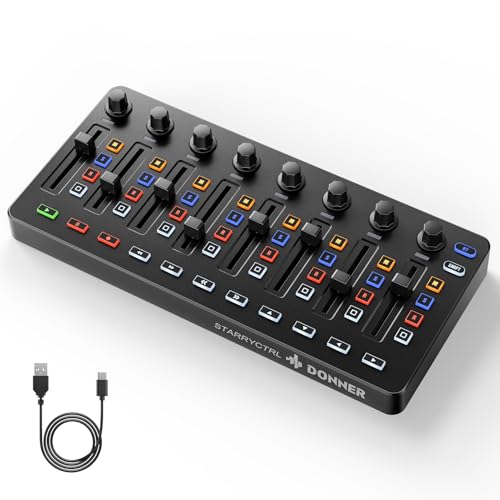
DONNER STARRYCTRL Wireless MIDI Controller, Portable USB
- ✓ Wireless and portable
- ✓ Easy Mackie Control setup
- ✓ Highly customizable controls
- ✕ Battery life could be longer
- ✕ Learning curve for advanced features
| Wireless Connectivity | Low-latency wireless technology with rechargeable 780mAh lithium battery |
| Power Supply | USB Type-C port for fast recharging |
| Faders and Knobs | 8 each, with LED anti-jump indicator support for soft takeover |
| MIDI Compatibility | Supports Mackie Control Universal (MCU) protocol, 43 assignable controls |
| Software Compatibility | Includes Cubase 15 LE and WaveLab for music production |
| Control Features | Supports customizable CC, Note messages, channel, aftertouch, and global controls |
The first time I unboxed the Donner STARRYCTRL, I was surprised to find how effortlessly it connected to my setup without any fuss. No tangled cables, no confusing software installs—just a quick charge and I was ready to go.
The built-in rechargeable battery instantly changed the game for me. I used it during a live session outdoors, and the wireless connection held strong, giving me total freedom of movement.
The low-latency performance meant I could tweak parameters in real time without lag, which is a huge plus for performers.
The LED anti-jump indicator is a clever touch. I accidentally moved a fader too fast during a mix and saw the flashing light pop up, warning me that the device was out of sync.
It’s a small feature but saves a lot of headaches during live tweaking.
The controls feel solid and responsive, with 8 sliders and 8 knobs that are easy to manipulate. Setting up Mackie Control was a breeze—just one click, and I was controlling my DAW seamlessly.
The fully customizable keys mean I can assign everything from CC messages to scene triggers, making it versatile for both studio and stage use.
Plus, the bundled Cubase LE and WaveLab software add real value, especially if you’re starting out or want to expand your music production. The deep customization options through MidiSuite mean you can tailor everything to your workflow, whether you’re producing, DJing, or live VJing.
Overall, this controller exceeded my expectations with its portability, ease of use, and professional features. It’s a solid pick for anyone who needs a flexible, wireless MIDI solution that keeps your workspace clean and your creativity flowing.
What Is a MIDI Slider Controller and How Does It Work?
A MIDI slider controller is a hardware device designed for musicians and producers to interact with digital audio workstations (DAWs) and other MIDI-compatible software. It features multiple sliders that allow users to manipulate various parameters, such as volume, pan, modulation, and effects, in real-time.
Key components and functionality include:
-
Sliders: Typically ranging from 4 to 16 sliders, each can control a different function in the software, enabling dynamic mixing and sound design.
-
MIDI Output: The device sends MIDI data to the connected software, translating physical movement of sliders into digital commands for seamless control over audio parameters.
-
User-Defined Assignments: Many MIDI slider controllers come with software that allows users to customize slider functions according to personal workflow needs.
-
Transport Controls: Additional buttons may include play, stop, and record functions, facilitating a smoother, more integrated production experience.
These controllers are especially valuable during live performances and studio settings, where hands-on control over the mixing process enhances creative expression and productivity. Examples of popular MIDI slider controllers include the Akai APC40 MKII and Novation Launch Control XL, both widely praised for their user-friendly design and robust functionality.
What Key Features Should You Look for in a MIDI Slider Controller?
When searching for the best MIDI slider controller, several key features should be considered to ensure it meets your needs.
- Number of Sliders: The quantity of sliders available on a MIDI controller is crucial as it determines how many parameters you can control simultaneously. More sliders provide greater flexibility and allow for more detailed mixing and automation of your sounds.
- Build Quality: A sturdy construction is important for durability, especially if you plan to transport the controller frequently. Look for materials that can withstand regular use and a design that feels solid and reliable.
- Compatibility: Ensure that the MIDI controller is compatible with your preferred DAW and operating system. Some controllers come with specific drivers or software that enhance functionality, while others may require additional setup for seamless integration.
- Customizability: The ability to customize controls and layouts can greatly enhance your workflow. Look for controllers that allow you to assign different functions to sliders and buttons, making it easier to adapt to different projects.
- Portability: If you plan on using your MIDI slider controller in various locations, consider its size and weight. A lightweight and compact design can be advantageous for musicians who perform live or travel frequently.
- Power Source: Some MIDI controllers can be powered through USB, while others may require an external power supply. USB-powered devices are generally more convenient for mobile setups, whereas external power may provide more stability in certain situations.
- Additional Controls: Beyond sliders, many MIDI controllers come with extra knobs, buttons, and pads that can enhance your control over software. These additional features can provide more versatility and expand your creative possibilities.
- Feedback Mechanism: Feedback through visual indicators, such as LED lights or screens, helps you understand the current settings and changes in real-time. This feature can be particularly useful during live performances or recording sessions.
- Price: While budget is always a consideration, it’s important to balance cost with features and quality. Investing in a slightly more expensive model may offer better longevity and functionality, making it a worthwhile choice in the long run.
What Are the Advantages of Using a MIDI Slider Controller?
Customizability allows users to tailor the controller to their specific production style, making it a versatile tool in various musical genres.
Portability is a crucial factor for musicians who perform live, as a lightweight and compact design ensures that they can easily transport their equipment without sacrificing functionality.
How Do MIDI Slider Controllers Impact the Music Production Process?
Customizability is another key feature of many MIDI slider controllers, enabling users to assign different functions to sliders based on their specific production needs or personal preferences. This flexibility means that producers can adapt their equipment to their workflow, making it an essential tool in the studio.
Lastly, integration with DAWs is a significant advantage, as most MIDI slider controllers are designed to work seamlessly with various digital audio workstations. This compatibility provides instant access to control multiple parameters, enhancing the user experience and efficiency in the music production process.
Which MIDI Slider Controller Is Best for Live Performances?
The best MIDI slider controllers for live performances include:
- Novation Launch Control XL: This controller is known for its robust build and extensive control features, making it ideal for live settings.
- Akai Professional APC40 mkII: Designed specifically for Ableton Live, this controller offers seamless integration and a user-friendly layout for performers.
- Korg nanoKONTROL2: This compact controller is lightweight and portable, perfect for musicians on the go who need essential slider controls.
- Arturia BeatStep Pro: Combining sequencing capabilities with MIDI control, the BeatStep Pro is versatile for both live performance and studio work.
- Native Instruments Komplete Kontrol S-Series: This controller features high-quality faders and is designed to work seamlessly with Native Instruments’ software, providing a rich performance experience.
Novation Launch Control XL: This controller features 24 sliders and 16 buttons that can be customized for various applications. The Launch Control XL is particularly favored for its compatibility with multiple DAWs, making it a versatile tool for live mixing and performance.
Akai Professional APC40 mkII: This controller includes 8 faders and a grid of pads, specifically optimized for Ableton Live, allowing for intuitive control over clips and mixer functions. Its layout is designed to enhance workflow during live shows, providing quick access to essential controls.
Korg nanoKONTROL2: With its slim design, the nanoKONTROL2 offers 8 faders and transport controls, making it an excellent choice for minimal setups. Its USB-powered design ensures easy connectivity, and it is particularly effective for musicians looking for a simple yet functional controller.
Arturia BeatStep Pro: This controller stands out with its dual sequencer functionality, allowing for complex performances that involve MIDI and CV outputs. It is ideal for performers who want to integrate hardware synthesizers and drum machines into their live setup.
Native Instruments Komplete Kontrol S-Series: This controller boasts a high-resolution display and touch-sensitive faders, providing a tactile experience that enhances live performance. Its integration with Komplete software allows for quick access to a vast array of sounds and effects, making it a powerful tool for any live musician.
What Is the Ideal MIDI Slider Controller for Home Studio Setup?
A MIDI slider controller is a hardware device that allows musicians and producers to control various parameters in digital audio workstations (DAWs) and music production software using physical sliders or faders. These controllers facilitate real-time adjustments of volume, pan, effects, and other sound parameters, enhancing the creative workflow in a home studio setup.
According to the MIDI Manufacturers Association, MIDI (Musical Instrument Digital Interface) technology enables communication between electronic musical instruments, computers, and other digital devices, allowing for a versatile and dynamic approach to music production.
Key aspects of an ideal MIDI slider controller include the number of sliders, their sensitivity, compatibility with different DAWs, and additional features like buttons, knobs, and pads. Controllers with at least eight sliders are popular for their ability to manage multiple tracks simultaneously, while the quality of the sliders affects the precision of control. Some controllers also offer motorized faders, which automatically adjust to match the settings in the DAW, providing a seamless user experience.
The impact of using a MIDI slider controller in a home studio is significant. It allows for more tactile interaction with music production software, which can enhance creativity and efficiency. A study by Sound on Sound indicates that producers who utilize hardware controllers report a more intuitive workflow compared to those who rely solely on a mouse and keyboard. Furthermore, the physical presence of a controller can help in performances, making it easier to manipulate sound in real time.
Benefits of incorporating a MIDI slider controller into a home studio include improved mixing capabilities, enhanced control over virtual instruments, and the ability to create more dynamic performances. These controllers can also support a variety of genres and styles, making them versatile tools for any producer. For instance, they can be used in electronic music production for precise control over synthesizer parameters or in live performances for real-time mixing.
Best practices for choosing a MIDI slider controller involve assessing personal workflow needs and studio space. It’s important to consider the controller’s compatibility with existing software and hardware, as well as user reviews on build quality and reliability. Notable models like the Behringer X-Touch Mini and Novation Launch Control XL are often recommended for their balance of features, price, and ease of use, making them suitable for both beginners and experienced producers.
How Can You Choose the Right MIDI Slider Controller for Your Needs?
Choosing the right MIDI slider controller involves considering various factors to meet your specific needs.
- Number of Sliders: The number of sliders on a controller can greatly impact its usability for different applications.
- Build Quality: The durability and feel of the controller are crucial for regular use, especially in live performance settings.
- Compatibility: Ensuring the controller works seamlessly with your DAW or software is essential for a smooth workflow.
- Additional Features: Extra functionalities like assignable buttons, knobs, or pads can enhance creativity and efficiency.
- Portability: If you plan to travel or perform live, the size and weight of the controller will be important considerations.
Number of Sliders: The number of sliders on a MIDI controller can range from a few to over a dozen. More sliders allow for greater control over multiple parameters and can be beneficial in complex productions or live settings where you need to manipulate various tracks simultaneously.
Build Quality: A MIDI slider controller’s build quality affects its longevity and performance. Controllers made from sturdy materials can withstand the rigors of frequent transportation and use, while those with a more fragile construction may not hold up as well over time.
Compatibility: Before purchasing, check that the MIDI slider controller is compatible with your preferred digital audio workstation (DAW) or any music software you intend to use. Many models offer plug-and-play capabilities, while others may require specific drivers or configurations to function properly.
Additional Features: Beyond sliders, many MIDI controllers come equipped with extra features like assignable knobs, pads, or transport controls. These features can provide more versatility in your workflow, allowing you to manage effects, trigger samples, or control mixing functions directly from the controller.
Portability: If you are a musician on the go, consider the size and weight of the MIDI slider controller. A lightweight and compact model can be beneficial for travel, while still offering the necessary controls for your performance or studio sessions.
Related Post: