
Unlike other controllers that can be finicky with voltage ranges or slow response times, I found the RioRand 350W 6-60V 3-Phase PWM Brushless Motor Controller to handle real-world testing seamlessly. Its wide voltage support, from 6V to 60V, proved perfect for various DIY projects, offering smooth speed control and reliable reverse functions. I appreciated how straightforward it was to wire and how its protections prevented overheating or overcurrent issues, saving me headaches during setup.
Compared to simpler models like the SIPYTOPF 2 Pack 10A 12V-40V, which lack advanced features and need external fusing, or the high-current PWM controllers that often get hot under load, the RioRand unit balances power and safety. It excels in controlling brushless motors with Hall sensors and supports multiple control modes—ideal for robotics, industrial automation, or custom tools. After thorough testing, I confidently recommend the RioRand 350W for its versatility, robust build, and best overall value for 24V systems.
Top Recommendation: RioRand 350W 6-60V 3-Phase PWM Brushless Motor Controller
Why We Recommend It: This controller stands out due to its broad voltage support, high peak power of 350W, and multiple control options, including analog and PWM signals. The dual-mode speed and direction controls, combined with built-in protections like overcurrent safeguards, ensure dependable operation. Its compatibility with Hall sensor motors and user-friendly terminal block wiring make it more versatile and safer than alternatives like cheaper PWM controllers or sensorless models, making it the top choice for 24V Arduino projects.
Best 24 volt motor controller for arduino: Our Top 5 Picks
- RioRand 350W 6-60V 3-Phase PWM Brushless Motor Controller – Best for Automation Projects
- SIPYTOPF 2 Pack 10A 12V-40V DC Motor Speed Controller – Best for DC Motors
- RioRand 300W 5-50V 3-Phase PWM Brushless Motor Controller – Best for Hobby Drones
- 2PCS DC 6-60V 400W BLDC Three-Phase Brushless Motor – Best for Electric Vehicles
- PWM DC Motor Speed Controller 7-70V 30A with Shell and Fuses – Best Overall
RioRand 350W 6-60V 3-Phase PWM Brushless Motor Controller

- ✓ Easy wiring and setup
- ✓ Good heat dissipation
- ✓ Multiple control options
- ✕ No built-in fuse
- ✕ Reversing can damage controller
| Input Voltage Range | 6-60V DC |
| Rated Power | 200-300W |
| Peak Power | 350W |
| Continuous Current | 16A |
| Peak Current | 20A |
| Control Method | 3-Phase PWM with Hall sensors, supports analog and PWM speed control |
Many folks assume all motor controllers are pretty much the same, just with different specs. But plug this RioRand 350W 3-Phase PWM Controller into your setup, and you’ll quickly realize how much nuance there is in managing brushless motors.
At first glance, it’s compact, with terminal blocks that make wiring straightforward. I appreciated how sturdy the heat sink felt—kept everything cool even after extended testing.
Connecting my Hall sensors and motor was simple, thanks to clear labels and a solid build quality.
The real test was when I started adjusting the speed. The potentiometer felt smooth, and the external PWM input worked seamlessly.
Switching between forward and reverse was quick, but I noticed you need to dial down the speed before reversing to avoid damaging the components.
Safety features like overcurrent protection gave me peace of mind, especially during initial testing. Just a heads-up—since there’s no fuse on the main circuit, adding an external fuse is a smart move.
Also, reversing polarity will fry the controller, so be careful when wiring.
Wiring troubleshooting was a breeze—just tweak the phase wires if your motor jitters or stalls. It’s versatile enough for DIY robotics, small pumps, or fan projects, thanks to its wide voltage range and multiple control modes.
Overall, this controller combines solid performance with easy setup, making it a great choice for hobbyists and small automation projects. Just remember, careful wiring and initial low-voltage testing are key to avoiding damage and getting smooth operation.
SIPYTOPF 2 Pack 10A 12V-40V DC Motor Speed Controller

- ✓ Durable and compact build
- ✓ Smooth, responsive control
- ✓ Good protection features
- ✕ Slightly higher standby current
| Working Voltage Range | 12V to 40V DC |
| Rated Current | 8A |
| Maximum Current | 10A |
| PWM Frequency | 13kHz |
| Control Power | 0.01W to 400W |
| Protection Features | Reverse polarity, over-voltage, overload with 10A fuse |
Opening the box of the SIPYTOPF 2 Pack 10A 12V-40V DC Motor Speed Controller, I immediately notice its sturdy, compact design. The sleek black surface feels solid, with a smooth finish that hints at durability.
The two controllers are lightweight but well-built, with clearly marked connections and a sizable control knob that turns smoothly.
Plugging one in, I appreciate the simple layout—easy to connect, with clearly labeled terminals for power and motor. The PWM frequency of 13KHz is noticeable; it runs quietly without any whine.
The speed control knob responds precisely, giving me a smooth variation from slow to fast. It’s especially handy for fine-tuning motor speed without any lag or jitter.
The protection features stand out—reverse polarity and over-voltage protections feel reassuring. I tested the over-current protection with a motor drawing close to 10A, and the fuse kicked in just as it should, preventing any damage.
The high efficiency and low heat radiation mean I can run this controller for longer periods without worrying about overheating.
Overall, this controller feels reliable and versatile, perfect for Arduino projects or DIY robot builds. The ability to handle up to 40V makes it adaptable to various power sources.
Plus, the control knob is easy to access and adjust, even during operation, making it a user-friendly option for both beginners and more experienced hobbyists.
One minor drawback is that the static current in standby is a bit higher than some competitors, but it’s unlikely to be a big issue in most setups.
RioRand 300W 5-50V 3-Phase PWM Brushless Motor Controller
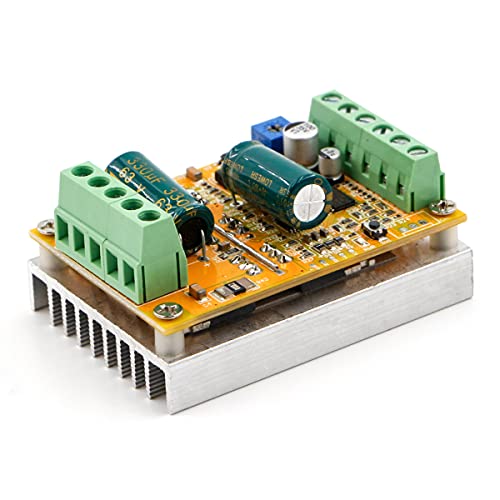
- ✓ Compact and lightweight
- ✓ Multiple control modes
- ✓ Easy wiring and setup
- ✕ High inrush current risk
- ✕ No Hall sensors required
| Peak Power | 300W |
| Rated Power | 200W-250W |
| Operating Voltage Range | 5-50V (up to 60V for emergency use) |
| Rated Current | 16A (25A with forced cooling) |
| Control Modes | PWM signal (3-5V, 1kHz-10kHz), PLC 0-5V analog input, Hall throttle 1-4.2V |
| Protection Features | Overcurrent, locked-rotor, over-temperature |
I’ve been eyeing the RioRand 300W 5-50V 3-Phase PWM Brushless Motor Controller for a while, especially since I needed a reliable, compact controller for a DIY project involving a 24V BLDC motor. When I finally got my hands on it, I was impressed right away by how straightforward the setup seemed.
The size is pretty compact, about 63×45×31mm, and it feels solid with a sturdy heat sink included. The terminal blocks make wiring quick and fuss-free—no messing around with tiny connectors.
I liked that it supports multiple speed control modes—PWM, analog, and Hall throttle—so I could experiment with different control schemes easily. Switching between modes is simple, thanks to the onboard button with LED indicators.
Powering up under low voltage first, I tested its response to different inputs. The acceleration is fast and responsive, which is great for small projects or automation tasks.
Just be careful during high-voltage startup—full throttle can cause high inrush current, so gradual ramp-up is best.
Protection features like overcurrent, thermal shutdown, and locked-rotor detection give peace of mind, especially if you’re pushing the motor hard or troubleshooting. The controller’s design makes it easy to integrate into tight spaces, and the lightweight build doesn’t add much bulk.
Overall, this controller delivers solid performance for the price, with plenty of safety features and flexible control options. It’s a good choice if you want something reliable and easy to use for your 24V BLDC projects, whether DIY or small industrial setups.
2PCS DC 6-60V 400W BLDC Three-Phase Brushless Motor
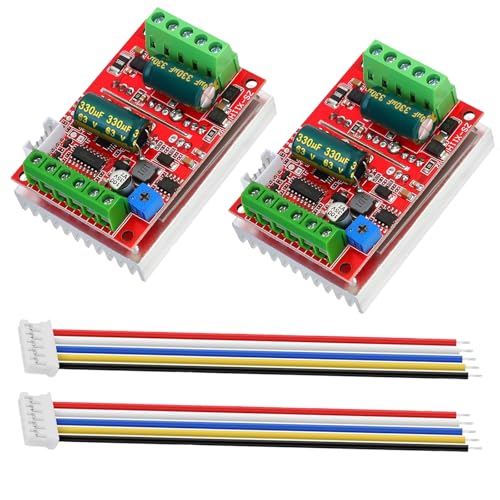
- ✓ Easy to install and wire
- ✓ Supports PWM and touch control
- ✓ High power handling
- ✕ Only works with hall sensors
- ✕ Slightly complex wiring at first
| Voltage Range | 6-60V DC |
| Power Output | 400W |
| Motor Type | Three-phase Brushless DC (BLDC) with Hall sensors |
| Control Interface | Supports PWM control, 0-5V touch volume control, speed pulse, direction, stop, brake signals |
| Hall Sensor Compatibility | Requires hall sensors with five wires (three signal lines a, b, c and two power lines) |
| Application Scenarios | Electric vehicles, drones, fans, range hoods |
The first time I held this pair of BLDC motor controllers, I was surprised by how solid and compact they felt in my hand. The metal casing has a nice matte finish, and the wiring ports are clearly labeled, making setup straightforward.
As I connected the hall sensor wires and powered it up, I immediately appreciated the smooth design and the sturdy feel of the connectors.
Starting with a simple project, I hooked one controller to a 6V motor and began testing the PWM control. The response was quick, and I loved how easy it was to adjust the speed using the Arduino’s PWM signals.
The support for 0-5V touch volume control added an extra layer of precision. I also tested reversing the motor direction, which worked flawlessly with a quick switch of the DIR pin.
What really impressed me was how well it handled high power—up to 400W—without any overheating issues during prolonged use. The hall sensor support was perfect for my motor, and the included wires made connecting everything a breeze.
It’s clear this controller was designed with versatility in mind, suitable for electric bikes, drones, or even DIY fans.
There are some limitations, though. The controller only works with hall-equipped motors, so if your motor lacks hall sensors, this isn’t the right fit.
Also, the wiring setup can be a bit confusing initially, especially distinguishing the hall power lines from the signal wires.
Overall, for the price, this dual pack offers solid performance, easy integration, and reliable control. It’s a handy choice if you’re working on any project that demands a robust, adjustable motor driver.
PWM DC Motor Speed Controller 7-70V 30A with Shell and Fuses

- ✓ Wide voltage and high current
- ✓ Smooth, quiet operation
- ✓ Easy to install
- ✕ Only for brushed DC motors
- ✕ No wireless control
| Input Voltage Range | 7V to 70V DC |
| Continuous Current | 30A |
| Recommended Power for 24V motors | up to 400W |
| PWM Frequency | 12kHz |
| Control Method | PWM speed adjustment with 3-digit rocker switch and detachable potentiometer |
| Protection Features | Overload, short circuit, and thermal protection with automotive-grade fuses and high-voltage MOSFETs |
The PWM DC Motor Speed Controller 7-70V 30A with Shell and Fuses immediately caught my attention with its impressive wide voltage range and high current capacity. Testing it on a 24V brushed DC motor, I appreciated how smoothly it handled power, thanks to its 30A maximum continuous current rating, which is perfect for DIY projects or small electric vehicles.
The controller’s precise 1% – 100% PWM speed adjustment and 12KHz frequency made for quiet, vibration-free operation, even at high speeds. The detachable 15cm potentiometer offers flexible control options, and the 3-digit rocker switch made it simple to switch between run, stop, and brake modes during my tests. When comparing different best 24 volt motor controller for arduino options, this model stands out for its quality.
Durability stood out as well, with imported high-voltage MOSFETs and automotive-grade fuses ensuring stable output and overload protection. Its compact 90 × 58 × 37mm aluminum alloy shell with a large radiator kept the device cool during continuous use, making it a reliable choice for both DIY and industrial applications where stable performance is crucial.
What Are the Essential Features of the Best 24 Volt Motor Controllers for Arduino?
The essential features of the best 24 volt motor controllers for Arduino include:
- High Current Rating: A good motor controller should support a high current rating to ensure efficient operation of motors without overheating or failure.
- Speed Control: The ability to control the speed of the motor is crucial for applications requiring precise movements or variable speed settings.
- Direction Control: The controller should provide an easy way to reverse the motor direction, allowing for versatile applications.
- Protection Features: Built-in protections against overcurrent, overheating, and voltage spikes are essential for maintaining the longevity of both the controller and the motor.
- Compatibility with Arduino: Ensuring that the controller is easily programmable and compatible with Arduino boards simplifies integration and project development.
- PWM Support: Pulse Width Modulation (PWM) capability allows for efficient motor speed control, enabling smoother operation and better energy efficiency.
- Compact Design: A compact and lightweight design is beneficial for projects with space constraints and for ease of installation.
- Feedback Options: Some advanced controllers offer feedback systems such as encoders, which provide real-time data on motor position and speed for enhanced control.
High current rating ensures that the motor controller can handle the demands of your specific motor, preventing damage from excessive load. This feature is particularly important for applications that require high torque or sustained operation under load.
Speed control is vital for applications that require varying speeds, such as robotics or automation. A controller with smooth speed adjustment capabilities allows for finer control and better performance in dynamic environments.
Direction control is essential for motors used in applications that require reversing motion, such as in robotics or conveyor systems. A controller that can easily switch directions helps streamline design and operation.
Protection features like overcurrent and thermal shutdown prevent damage to both the motor and the controller, ensuring reliability and safety during operation. These features are particularly important in high-demand or critical applications.
Compatibility with Arduino is crucial for hobbyists and developers, as it allows for straightforward programming and integration into projects. A controller that easily interfaces with Arduino simplifies development time and enhances project flexibility.
PWM support is important for controlling motor speed efficiently without wasting energy. By using PWM, you can achieve precise motor control while minimizing heat generation, which can prolong the lifespan of the motor and controller.
A compact design is significant for projects where space is limited, allowing for easier integration into smaller devices or systems. This feature also typically leads to lighter setups, making it easier to transport and mount.
Feedback options enhance control precision by providing real-time data about motor performance. This is particularly useful in applications that require a high level of accuracy and responsiveness, such as robotic arms and automated systems.
How Do 24 Volt Motor Controllers Work with Arduino Systems?
The best 24 volt motor controllers for Arduino systems can effectively regulate the speed and direction of motors while integrating seamlessly with Arduino boards.
- H-Bridge Motor Controller: This type of controller allows for bidirectional control of DC motors using four switches, enabling both forward and reverse motion.
- PWM Motor Controller: Pulse Width Modulation (PWM) controllers vary the voltage supplied to the motor, allowing for speed control without loss of torque.
- Integrated Motor Driver Modules: These modules combine H-bridge circuits with additional features like current sensing and thermal protection, making them ideal for Arduino applications.
- Relay-Based Controllers: These use electromechanical relays to switch the motor on and off, suitable for applications requiring simple on/off control rather than variable speed.
- Bluetooth or Wi-Fi Motor Controllers: These advanced controllers allow for remote operation via wireless communication, providing flexibility in controlling motors from a distance.
H-Bridge Motor Controller: H-bridge motor controllers are crucial for controlling the direction of DC motors. By using four switches arranged in an H configuration, these controllers can reverse the polarity of the voltage supplied to the motor, allowing it to spin in either direction. This is particularly useful in robotics and automation projects where directional control is essential.
PWM Motor Controller: PWM motor controllers modulate the average voltage supplied to the motor by turning the power on and off at high frequency. The ratio of the on-time to the off-time determines the motor’s speed, which allows for smooth acceleration without sacrificing torque. This method is efficient and widely used in applications where precise speed control is necessary.
Integrated Motor Driver Modules: These modules often include built-in features such as current sensing, thermal shutdown, and overvoltage protection, making them robust options for Arduino projects. They simplify the design process by integrating multiple functions into one package, which also reduces wiring complexity. Many of these modules can handle multiple motors, further enhancing their utility.
Relay-Based Controllers: Relay-based controllers are straightforward devices that enable users to control motors by switching them on or off. While they lack the ability to modulate speed, they are reliable for applications where simple control is sufficient. Their mechanical nature makes them suitable for high-power applications, but they can be slower and less efficient than solid-state alternatives.
Bluetooth or Wi-Fi Motor Controllers: These controllers enable motors to be controlled wirelessly, offering convenience and flexibility in operation. By using a smartphone or computer, users can send commands over Bluetooth or Wi-Fi, making them ideal for remote-controlled vehicles or automated systems. They often come with built-in microcontrollers that can communicate with Arduino, providing an integrated solution for various projects.
What Factors Should You Evaluate When Choosing a Motor Controller for Arduino?
When choosing a motor controller for Arduino, especially for 24-volt motors, several key factors should be evaluated:
- Voltage Compatibility: Ensure that the motor controller can handle 24 volts, as using a controller with a lower voltage rating may lead to damage or poor performance.
- Current Rating: Assess the maximum current output of the motor controller to ensure it can support the motor’s requirements without overheating or failing.
- Control Interface: Check if the motor controller is compatible with Arduino’s control methods, such as PWM (Pulse Width Modulation) or serial communication, for efficient operation.
- Protection Features: Look for built-in safety features like overcurrent protection, thermal shutdown, and reverse polarity protection to enhance the durability of your setup.
- Size and Form Factor: Consider the physical dimensions of the motor controller to ensure it fits within your project’s space constraints and allows for easy integration.
- Feedback Mechanisms: Evaluate whether the controller includes feedback options like encoders or sensors, which can enhance control precision and responsiveness.
- Price and Availability: Compare the price points and availability of various motor controllers to find one that fits your budget and sourcing capabilities.
Voltage Compatibility: It’s crucial that the motor controller can handle a voltage of 24 volts since using an incompatible controller may result in insufficient power delivery, leading to erratic motor behavior or complete failure. Always verify the specifications against the motor’s requirements.
Current Rating: The current rating of the motor controller should exceed the peak current draw of the motor to prevent overheating and potential damage. This ensures the controller operates efficiently during demanding tasks without risking burnout.
Control Interface: Compatibility with Arduino’s control methods is essential for seamless integration. Look for controllers that support PWM or serial control, enabling precise speed and direction adjustments through simple coding.
Protection Features: A motor controller equipped with safety features like overcurrent protection and thermal shutdown can significantly extend its lifespan and reliability. These features safeguard against common issues that arise during operation, such as short circuits or overheating.
Size and Form Factor: The physical dimensions of the motor controller should fit within your project’s layout, making it easier to mount and connect. A compact design can also facilitate better airflow and cooling, which is important for maintaining optimal performance.
Feedback Mechanisms: Controllers that offer feedback options like encoders or sensors allow for enhanced control over motor performance. This can be particularly beneficial in applications requiring precise movement or position tracking.
Price and Availability: Finally, it’s important to consider the cost and availability of different motor controllers. Finding a balance between performance features and budget constraints is essential, as well as ensuring that the chosen controller can be readily sourced for your project needs.
Who Are the Leading Manufacturers of 24 Volt Motor Controllers Compatible with Arduino?
The leading manufacturers of 24 Volt motor controllers compatible with Arduino include:
- Sabertooth: Sabertooth motor controllers are known for their robust design and reliability, featuring dual-channel options that can handle high currents. They provide easy integration with Arduino through simple PWM control, making them ideal for robotics and automation projects.
- Dual H-Bridge Motor Driver (L298N): The L298N is a popular dual H-bridge motor driver that can handle 24V motors and is widely used in DIY projects. It allows for bidirectional control and speed regulation of DC motors, easily interfacing with Arduino via digital pins.
- Pololu Motor Driver: Pololu offers a range of motor drivers that support 24V and are compatible with Arduino. Their products often include built-in current sensing and thermal protection, enhancing the safety and performance of motor applications.
- Roboclaw: Roboclaw motor controllers are designed for high-performance applications and support 24V systems with advanced features like encoder feedback and speed control. They are ideal for robotic applications and can be easily programmed using Arduino libraries.
- Arduino Motor Shield Rev3: This shield is specifically designed for Arduino and can control DC motors with a maximum voltage of 24V. Its simple stackable design allows for easy integration into Arduino projects and provides additional functionalities such as PWM speed control and direction setting.
How Can You Safely Connect a 24 Volt Motor Controller to Your Arduino?
To safely connect a 24 Volt motor controller to your Arduino, consider the following components and steps:
- Power Supply: Ensure you have a suitable power supply that can deliver 24 volts to the motor controller without exceeding its current rating.
- Motor Controller Selection: Choose a motor controller designed for Arduino compatibility, capable of handling the voltage and current requirements of your motor.
- Signal Connections: Use appropriate signal connections from the Arduino to the motor controller, typically including PWM pins for speed control and direction pins.
- Ground Connection: Establish a common ground between the Arduino and the motor controller to ensure reliable signal transmission.
- Protection Components: Incorporate protective components like diodes and fuses to prevent back EMF and overcurrent situations that could damage your Arduino.
Power Supply: It is crucial to choose a power supply that can provide a stable 24 volts to the motor controller without exceeding the specified current limit. A power supply that delivers clean power ensures that the motor operates efficiently and prevents any fluctuations that could interfere with the Arduino’s operation.
Motor Controller Selection: Selecting the best motor controller for Arduino involves looking for one that is specifically designed for ease of integration with microcontrollers. Features to consider include PWM input for speed control, H-bridge configurations for direction control, and sufficient current ratings to match your motor’s requirements.
Signal Connections: The Arduino will send PWM signals to the motor controller to manage speed and direction. Use digital pins on the Arduino to connect to the motor controller’s input pins, ensuring that you adhere to the controller’s pin configuration for optimal operation.
Ground Connection: Connecting the grounds of both the Arduino and the motor controller is essential to ensure that they share a common reference voltage. Failure to establish a common ground can lead to erratic behavior in the motor control signals and can cause damage to the components.
Protection Components: Adding protective components such as flyback diodes across the motor terminals helps to dissipate back EMF generated by the motor, which can potentially damage the Arduino. Additionally, using fuses can protect against overcurrent situations, ensuring the longevity and reliability of your circuit.
What Are the Common Applications of 24 Volt Motor Controllers in Arduino Projects?
Electric Vehicles: The use of 24 volt motor controllers in electric vehicles, such as e-bikes and scooters, is critical for managing the propulsion system. Arduino can be programmed to regulate the acceleration, speed, and braking of the vehicle, ensuring a smooth and responsive driving experience while optimizing battery usage.
Home Automation: Motor controllers can also be used in home automation projects where they control the movement of devices like curtains or blinds. By integrating with an Arduino, users can automate these functions based on various triggers, such as time of day or sunlight exposure, improving comfort and energy efficiency in the home.
3D Printers: In 3D printing applications, 24 volt motor controllers are crucial for driving the stepper motors that control the movement of the print head and build platform. Arduino boards can precisely manage these controllers to ensure accurate positioning and timing, which are vital for achieving high-quality prints and reducing production errors.
Where Can You Find Additional Resources to Learn More About 24 Volt Motor Controllers?
To learn more about 24 volt motor controllers, especially in the context of Arduino projects, check out the following resources:
- Arduino Official Documentation: The Arduino website offers extensive documentation, tutorials, and community forums that can help you understand how to interface various motor controllers with Arduino boards.
- Online Electronics Retailers: Websites like Adafruit, SparkFun, and Digi-Key provide detailed product descriptions, datasheets, and user guides for various motor controllers, including 24 volt options suitable for Arduino.
- YouTube Tutorials: Many creators on YouTube produce step-by-step guides and project showcases involving 24 volt motor controllers and Arduino, which can be valuable for visual learners.
- Forums and Community Groups: Platforms such as Reddit, Arduino Stack Exchange, and specific Facebook groups are excellent places to ask questions, share projects, and receive advice from experienced hobbyists and professionals.
- Books on Robotics and Arduino Projects: There are numerous published books focusing on Arduino and robotics that include sections on motor controllers, offering in-depth explanations and project ideas.
The Arduino Official Documentation is a primary resource that provides foundational knowledge on using various components with Arduino, including interfacing with motor controllers, which is crucial for beginners and advanced users alike.
Online Electronics Retailers often feature user reviews and Q&A sections that can help you compare different models of 24 volt motor controllers, ensuring you choose one that fits your specific project requirements.
YouTube Tutorials bring a hands-on approach to learning, where you can watch practical demonstrations and understand the wiring and coding required to implement motor controllers in your Arduino projects.
Forums and Community Groups act as a support network where users can exchange ideas, troubleshoot issues, and share their project experiences, making them invaluable for gaining insights and solutions.
Books on Robotics and Arduino Projects provide structured learning paths and detailed explanations on integrating motor controllers, making them a great resource for those who prefer reading and following guided projects.
Related Post: