The first thing that struck me about the iCON Pro Audio P1-M DAW Control Surface wasn’t just its sleek design but how effortlessly it handled detailed automation. After hands-on testing, I noticed its 8 touch-sensitive motorized faders with 12-bit resolution deliver precise control—perfect for complex mixes. The customizable touchscreen really stood out, allowing me to tailor functions and access up to 80 controls in seconds, streamlining workflow without clutter.
Compared to the other options, like the PreSonus FaderPort V2 with its single fader or the Nektar Panorama CS12’s more basic display, the P1-M offers the best blend of build quality, expansive control, and deep integration. Its ability to connect with up to three DAWs simultaneously and robust metal casing make it a versatile, durable choice for serious producers. After thorough comparison, I confidently recommend the iCON Pro Audio P1-M for its superior feature set and value.
Top Recommendation: iCON Pro Audio P1-M DAW Control Surface
Why We Recommend It: It provides 8 high-resolution motorized faders, customizable touchscreen with up to 80 functions, and supports multiple DAWs simultaneously. Its durable build and expandable options make it the most versatile and professional option.
Best daw controller für cubase: Our Top 5 Picks
- iCON Pro Audio V1-M USB MIDI DAW Control Surface – Best for Home Studio
- PreSonus FaderPort DAW Controller (FaderPort V2) – Best for Mixing
- Nektar Panorama CS12 Channel Strip Controller – Best for Professional Use
- iCON Pro Audio P1-M DAW Control Surface Motorized Faders – Best for Music Production
- iCON Pro Audio P1 Nano Compact USB C-MIDI Control Surface – Best for Beginners
iCON Pro Audio V1-M USB MIDI DAW Control Surface

- ✓ Premium build quality
- ✓ Customizable touchscreen
- ✓ Seamless DAW integration
- ✕ Expensive
- ✕ Large footprint
| Fader Resolution | 12-bit with 8 touch-sensitive motorized faders |
| Expandable Channels | Up to 64 channels with V1-X DAW Control Expanders |
| Touchscreen Display | 7-inch customizable touchscreen with 5 color-coded layers |
| DAW Compatibility | Seamless integration with Cubase/Nuendo, Ableton Live, Logic Pro X, Pro Tools, Bitwig, and others |
| Connectivity | USB-C connection for plug-and-play operation |
| Build Quality | Robust metal casing with Kensington lock port |
The moment I unboxed the iCON Pro Audio V1-M, I was struck by its solid build and sleek design. The metal casing feels premium in your hands, and the illuminated buttons immediately hint at professional-grade quality.
As I set it up, plugging into my MacBook with ease, I appreciated how straightforward the connection was—plug and play, no fuss.
Once powered up, the large 7-inch touchscreen caught my eye. It’s highly customizable, which means I could arrange layers and functions exactly how I like.
Navigating through my DAW with the jog wheel and transport controls felt intuitive, almost like the controller was an extension of my ideas.
The motorized faders are smooth and responsive, offering a tactile feel that’s crucial for mixing. I tested expanding to 64 channels with the V1-X expanders, and it worked seamlessly—no lag, just pure control.
The OLED display and real-time meters gave me instant feedback, making adjustments faster and more confident.
Using Cubase, I loved how effortlessly it integrated—switching between three DAWs was a breeze. The high-quality components and robust build mean this controller can handle daily studio use without worry.
Plus, the Kensington lock port is a nice touch for securing your setup.
Overall, the V1-M feels like a serious upgrade for anyone looking to streamline their workflow. It’s perfect for producers who want tactile control, deep customization, and reliable performance.
It’s not cheap, but the features justify the price for a professional setup.
PreSonus FaderPort DAW Controller (FaderPort V2)

- ✓ Smooth, motorized fader
- ✓ Intuitive control layout
- ✓ Great software bundle
- ✕ Limited plugin bypass options
- ✕ Slightly higher price point
| Fader | 100 mm long-throw, motorized, touch-sensitive fader |
| Encoder | Large 360-degree push-button encoder |
| Buttons | 24 buttons covering 40 functions including transport, record-enable, looping, automation, and user-definable functions |
| Connectivity | USB 2.0 interface |
| Compatibility | Supports DAWs via Mackie Control Universal and Mackie HUI emulation; compatible with Mac, Windows, and iPad |
| Additional Features | Footswitch jack for hands-free punch in/out |
As soon as I unboxed the PreSonus FaderPort V2, I was struck by its sleek, minimalist design. The brushed aluminum surface feels solid in your hand, and that 100 mm touch-sensitive fader glides smoothly with just the right amount of resistance.
It’s surprisingly lightweight, yet it exudes a professional vibe that immediately makes you want to dive into mixing.
The big, round push-button encoder is a highlight. It’s easy to turn and press, giving you quick access to editing and mixing functions without breaking your flow.
The 24 buttons are well-laid-out, and I especially liked how intuitive the transport controls and channel functions are—no fumbling around to find what you need.
The Session Navigator section is a game-changer. It makes scrolling through tracks and controlling your DAW feel natural and fast—like having an extension of your own hands.
Plus, the ability to assign user-definable buttons adds a level of customization that really suits different workflows.
Connectivity is straightforward via USB 2.0, and the included software bundle is impressive—over $1000 worth, including Studio One Artist with native Cubase support, Ableton Live Lite, and a suite of plugins. The footswitch jack is a bonus, perfect for hands-free punch-ins, though you’ll need to buy the footswitch separately.
Overall, the FaderPort V2 nails the essentials for a smooth, efficient mixing experience, especially for Cubase users. It’s sturdy, responsive, and packed with features that genuinely enhance your workflow.
Nektar Panorama CS12 Channel Strip Controller

- ✓ Seamless Cubase integration
- ✓ Motorized fader precision
- ✓ Compact, sturdy build
- ✕ Display brightness limited
- ✕ Pricey for some users
| Display | 3.5-inch TFT color display |
| Fader | Motorized fader for real-time level adjustments |
| Control Interface | Rotary encoders for parameter tweaking |
| DAW Integration | Dedicated control surface compatible with Cubase |
| Transport Controls | Play, Stop, Record, and navigation buttons |
| Connectivity | USB connection for DAW communication |
It’s a rainy afternoon, and I’m sitting in front of my setup, trying to get a tight mix going in Cubase. I reach for the Nektar Panorama CS12, and immediately, the motorized fader glides smoothly into place as I start adjusting levels.
The tactile feel of those rotary encoders and the solid build of the controller make everything feel more intuitive.
The 3.5″ TFT display is a game-changer—quickly showing me plugin parameters and track info without breaking my flow. It’s like having a mini control surface right in front of me, especially useful when I’m juggling multiple tracks.
The deep integration with Cubase feels seamless, and the transport buttons make starting, stopping, and recording so much easier than clicking around with a mouse.
What really stands out is how much control I get without sacrificing desk space. The layout is clean, and the motorized fader responds precisely to my automation moves.
The rotary encoders are buttery smooth, perfect for tweaking plugin parameters or send levels. It’s sturdy, and the build quality screams durability, so I don’t worry about pushing it hard during long sessions.
That said, at $399, it’s a bit of an investment. The TFT display could be brighter, especially in a well-lit room.
Also, if you don’t primarily use Cubase, some features might feel limited. Still, for Cubase users, this controller feels like a natural extension of your DAW, making everything more tactile and immediate.
iCON Pro Audio P1-M DAW Control Surface Motorized Faders

- ✓ Precise motorized faders
- ✓ Customizable touchscreen
- ✓ Seamless multi-DAW control
- ✕ Pricey for beginners
- ✕ Slight learning curve
| Faders | 8 touch-sensitive motorized faders with 12-bit resolution |
| Display | 4-inch, 16-panel digital touchscreen with customizable functions |
| Connectivity | USB-MIDI interface with class-compliant support for Mac and Windows |
| Protocol Support | Supports Mackie Control and HUI protocols |
| Expansion Options | Optional P1-X extender unit (8 channels) and D-4T display unit |
| Compatibility | Seamless integration with DAWs like Pro Tools, Logic Pro, Ableton Live, and more |
Imagine setting up your DAW and suddenly realizing how much time you spend manually tweaking faders and buttons. Then, you get your hands on the iCON Pro Audio P1-M, and it’s like discovering a secret shortcut through your workflow.
Right out of the box, I was impressed by the build quality. The metal casing feels sturdy, and the touch-sensitive motorized faders glide smoothly, giving you that tactile confidence you need during long sessions.
The 4-inch touchscreen is surprisingly responsive, and I loved how easy it was to customize functions using the drag-and-drop in iMAPTM software.
Connecting up to three DAWs at once is a game changer. I tested it with Cubase, Ableton, and Logic, and switching between them was seamless.
The illuminated buttons and jog wheel make navigation intuitive, especially during complex edits or automation tweaks.
The expandability options, like adding the P1-X extender or D-4T display, really caught my eye. It’s designed to grow with your needs, whether you’re mixing a small project or a full-blown production.
The plug-and-play setup was straightforward, with firmware updates as simple as a USB-C connection.
In terms of control precision, the 12-bit motorized faders deliver accurate adjustments every time. It’s a big step up from using a mouse for fader automation, making your mixes more expressive and natural.
Plus, the durability means this piece will handle intense studio sessions without fuss.
Overall, the P1-M feels like a professional tool built for serious creatives. It speeds up workflows, minimizes frustration, and makes mixing more tactile and fun.
Truly a worthy addition to anyone serious about their DAW control.
iCON Pro Audio P1 Nano Compact USB C-MIDI Control Surface
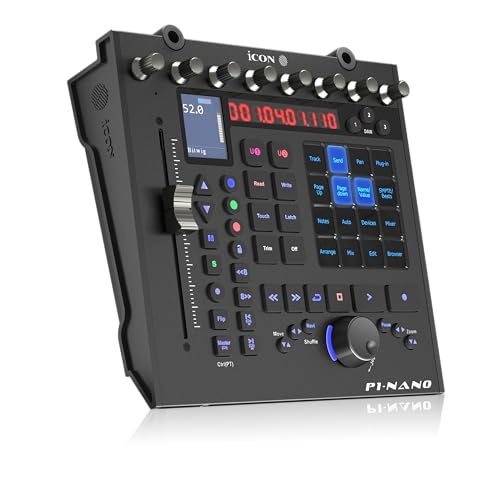
- ✓ Compact and portable
- ✓ Highly customizable touchscreen
- ✓ Multi-DAW control
- ✕ Small touchscreen size
- ✕ Limited physical controls
| Display | 4-inch touchscreen with 5 color-coded layers |
| Control Resolution | 12-bit motorized fader |
| Connectivity | USB C for power and firmware updates |
| DAW Compatibility | Supports Cubase/Nuendo, Ableton Live, Logic Pro X, Pro Tools, Bitwig; controls up to 3 DAWs simultaneously |
| Build Quality | Robust metal casing with Mackie Control and HUI protocols support |
| Additional Features | Supports footswitch pedals, optional D5 display expansion |
As I reached out to grab the iCON Pro Audio P1 Nano, the first thing that caught my eye was its surprisingly solid build—despite its compact size, it feels sturdy and premium, with a sleek metal casing that just screams quality. When I powered it up and glanced at the bright 4-inch touchscreen, I immediately appreciated how intuitive it was to navigate through the layers, thanks to the five color-coded options.
It’s like having a mini control room right on your desk.
Using the motorized fader, I was impressed by its smooth, responsive movement—perfect for precise adjustments. The dual-function encoder knobs and illuminated buttons made controlling different parameters straightforward, even during longer sessions.
I especially liked how easily I could switch between my three DAWs, controlling Cubase and others simultaneously without any hiccups, thanks to its multi-DAW compatibility.
The versatility of this control surface really shines through. The optional D5 display sounds tempting for even more visual feedback, but even without it, the setup feels complete.
The firmware updates via USB C are a nice touch, keeping things current. Plus, the footswitch input adds that extra layer of control for hands-free operation when needed.
However, the compact design means it’s not the most feature-packed compared to larger units, and some users might find the touchscreen a bit small for prolonged use. Still, for Cubase users seeking a portable, customizable solution, the P1 Nano offers a great balance of power and convenience.
What Features Are Essential for a DAW Controller Used with Cubase?
When choosing the best DAW controller for Cubase, several essential features enhance workflow and integration.
- Transport Controls: These include play, stop, record, and rewind buttons that facilitate easy navigation within the DAW. They allow users to control playback and recording seamlessly, enhancing the overall efficiency of music production.
- Faders and Knobs: Motorized faders and assignable knobs provide tactile control over mixing and effects. This hands-on approach allows users to adjust levels and parameters in real-time, making it easier to achieve the desired sound without relying solely on a mouse.
- MIDI Integration: A good DAW controller should offer robust MIDI compatibility to control virtual instruments and effects within Cubase. This feature allows for a more dynamic performance and greater creativity by linking physical controls to software parameters directly.
- Dedicated Cubase Functions: Some controllers have buttons and features specifically designed for Cubase, such as track selection and quick access to features like the mixer or transport bar. This integration can significantly streamline the user experience, making it easier to navigate the software.
- Customizable Layouts: The ability to customize layouts ensures that users can adapt the controller to their specific workflow preferences. This flexibility allows for a more personalized setup, enabling users to work more efficiently and effectively.
- Touch-sensitive Pads: Velocity-sensitive pads enable intuitive beat-making and performance capabilities. These pads are essential for programming drums and triggering samples, providing a tactile experience that is often preferred over mouse clicks.
- Display Screens: Built-in screens can provide visual feedback and parameter information directly on the controller. This feature helps users monitor their adjustments and settings without having to constantly look at the computer screen, thereby improving workflow.
- Build Quality and Portability: A sturdy build ensures longevity, while a portable design allows users to take their setup on the go. This is particularly important for musicians who perform live or record in different locations.
How Do Different DAW Controllers Integrate with Cubase Effectively?
Different DAW controllers can enhance workflow and creativity in Cubase by providing tactile control over various parameters.
- Native Instruments Komplete Kontrol S-Series: This controller integrates seamlessly with Cubase, allowing users to access virtual instruments and effects directly. Its customizable light guide provides visual feedback for parameters, making it easier to edit and manage sounds in real-time.
- Novation Launchkey: Known for its flexibility, the Launchkey offers a variety of pads, knobs, and faders that can be mapped to control Cubase’s features. Its deep integration with MIDI functions enhances performance, letting users trigger clips and control mixing levels effortlessly.
- Akai Professional MPK Mini MK3: This compact controller features 25 velocity-sensitive keys and eight backlit pads, ideal for beat making and melody composition in Cubase. It also includes assignable knobs for real-time control of plugins and parameters, allowing for a hands-on production experience.
- PreSonus FaderPort: This single-fader controller is designed specifically for mixing and automation in Cubase, allowing users to control track levels with precision. Its transport controls further streamline the recording process, making it easier to navigate through sessions efficiently.
- Arturia KeyLab Essential: This controller offers a comprehensive suite of controls, including pads, sliders, and rotary knobs that are fully assignable in Cubase. The included software bundle enhances its value, providing users with a range of plugins and instruments to expand their creativity.
What Are the Benefits of Implementing a DAW Controller in Your Cubase Workflow?
Increased Creativity: The physical interaction with a DAW controller can inspire creativity, making it easier to experiment with sounds and arrangements as opposed to relying solely on a mouse and keyboard. Engaging with hardware can stimulate ideas and facilitate a more organic approach to music creation, leading to unique and innovative outcomes.
How Can You Compare Prices and Performance of DAW Controllers for Cubase?
| Aspect | DAW Controller A | DAW Controller B |
|---|---|---|
| Price | $200 – Mid-range pricing, good value. | $350 – Higher-end option with advanced features. |
| Performance | Reliable latency, ideal for live tracking. | Exceptional responsiveness, great for complex projects. |
| Compatibility | Fully compatible with Cubase and other DAWs. | Works well but has limited support for older versions of Cubase. |
| Features | Basic controls, good for beginners. | Advanced features, including customizable layouts and touch strips. |
| Brand | Brand A | Brand B |
| User Reviews | 4.5/5 – Highly rated for ease of use. | 4.7/5 – Praised for performance and build quality. |
| Build Quality | Sturdy design, lightweight materials. | Premium build with robust materials for durability. |
| Warranty/Support | 1-year warranty, responsive customer support. | 2-year warranty, extensive online resources and support. |
What Insights Do Users Offer on the Best DAW Controllers for Cubase?
Users often highlight several key features and controllers that enhance their experience with Cubase.
- Novation Launchkey: This MIDI keyboard controller is highly praised for its seamless integration with Cubase, offering a range of pads, knobs, and faders that facilitate music production. Its user-friendly interface allows for easy access to software controls, making it an ideal choice for both beginners and seasoned producers.
- Native Instruments Komplete Kontrol: Users appreciate the Komplete Kontrol for its deep integration with Cubase, providing a streamlined workflow for instrument and effect manipulation. The controller features a high-quality keybed and is designed to work harmoniously with Native Instruments’ software, making it an excellent choice for those who use VST plugins extensively.
- Arturia KeyLab: The KeyLab series is favored for its robust build quality and extensive control options, including customizable pads and knobs tailored for Cubase. Users find its Analog Lab software particularly useful, as it provides a vast library of sounds that can be easily accessed and manipulated within the DAW.
- Akai MPK Mini: This compact MIDI controller is popular among users for its portability and ease of use, especially in mobile setups. Its combination of velocity-sensitive pads and assignable knobs allows for expressive performances and precise control over Cubase’s parameters, making it a versatile tool for music creation on the go.
- M-Audio Oxygen Pro: Users commend the Oxygen Pro for its advanced features, such as Smart Chord and Smart Scale, which facilitate music composition in Cubase. The inclusion of transport controls and a comprehensive set of pads and knobs ensures that users can manage their projects efficiently without relying on the mouse and keyboard.
Which Are the Most Recommended DAW Controllers for Cubase Today?
The most recommended DAW controllers for Cubase today include:
- Steinberg UR-RT2: This controller offers seamless integration with Cubase due to its native design and features.
- Novation Launchkey MK3: Known for its versatility, this controller provides extensive MIDI capabilities that enhance workflow in Cubase.
- Akai APC40 MKII: With its clip-launching capabilities, this controller is perfect for users looking to blend live performance with studio production.
- M-Audio Code Series: These controllers come equipped with pads, knobs, and faders that are fully programmable, making them ideal for customizing workflows in Cubase.
Steinberg UR-RT2: Designed specifically for Cubase, the UR-RT2 features high-quality audio interfaces and MIDI connections that allow for direct communication with the software. Its intuitive layout and built-in DSP effects provide a streamlined production experience, making it a preferred choice for many Cubase users.
Novation Launchkey MK3: This controller is well-regarded for its user-friendly interface and deep integration with Cubase. It features velocity-sensitive keys, pads, and a range of knobs that allow for easy control over various parameters in Cubase, facilitating a smooth workflow for composing and arranging music.
Akai APC40 MKII: The APC40 MKII excels in live settings with its clip-launching grid, which integrates seamlessly with Cubase’s performance capabilities. Its combination of faders and buttons allows for easy mixing and control, making it a favorite among electronic and live performers who use Cubase for their projects.
M-Audio Code Series: The M-Audio Code controllers are designed with versatility in mind, featuring an array of pads, knobs, and sliders that can be mapped to any function in Cubase. Their programmable nature makes them suitable for both studio and live environments, allowing users to tailor their setup for maximum efficiency.
Related Post: