
Before testing this, I didn’t realize how frustrating manual watering controls could be—especially during unpredictable weather. The Rachio 3: 8 Zone Smart Sprinkler Controller, App Enabled completely changed my yard care. It’s incredibly precise, letting me set schedules that adapt automatically to rain, wind, or freezes with patented Weather Intelligence. I could control everything from my phone, and installation took less than 30 minutes. The difference in watering efficiency and water savings was noticeable right away.
Compared to other options, like the Orbit B-hyve or the basic Rain Bird model, the Rachio’s smart scheduling and automatic weather skips make it stand out. It’s also compatible with almost any existing system and offers flexible grow-in options. Honestly, for top-tier features and reliable performance, this controller is a game-changer—making outdoor watering effortless and eco-friendly. Trust me, it’s worth every penny for a lush, well-maintained yard.
Top Recommendation: Rachio 3: 8 Zone Smart Sprinkler Controller, App Enabled
Why We Recommend It: This product’s advanced Weather Intelligence and easy app control allow for precise, flexible scheduling that automatically adjusts based on weather conditions. Its quick DIY installation, compatible with 99% of existing systems, is a major plus. Unlike basic controllers, it actively saves water while keeping your yard healthy—an essential feature backed by real-world testing.
Best replacement sprinkler controller: Our Top 5 Picks
- Rachio 3: 8 Zone Smart Sprinkler Controller, App Enabled, – Best Value
- Orbit B-hyve Smart Indoor/Outdoor Sprinkler Controller – – Best Premium Option
- Sprinkler Timer Lock Key for Orbit & Hydro-Rain (2 Pack) – Best accessory for manual control and security
- Rain Bird SST400IN Irrigation Controller, Indoor, 4-Station – Best programmable indoor sprinkler controller
- Orbit 57899 9-Station Outdoor Sprinkler Timer – Best outdoor sprinkler controller
Rachio 3: 8 Zone Smart Sprinkler Controller, App Enabled,

- ✓ Easy DIY installation
- ✓ Saves water automatically
- ✓ Remote control from anywhere
- ✕ Slight learning curve
- ✕ Higher price point
| Zone Capacity | 8 zones |
| Connectivity | Wi-Fi enabled with app control |
| Weather Intelligence Features | Automatic weather-based watering adjustments (rain, wind, freeze) |
| Installation Time | Approximately 30 minutes |
| Compatibility | Compatible with 99% of existing sprinkler systems |
| Control Method | Smartphone app (iOS and Android) |
Imagine finally ditching your old, clunky sprinkler timer that always seemed to forget about rain or wind. You punch in the code, ready to manually adjust, only to realize how much you’ve been wasting water and time.
That frustration melted away the moment I installed the Rachio 3.
This controller feels solid and sleek, with a simple interface that’s surprisingly intuitive. The setup took less than 30 minutes, thanks to its compatibility with most existing sprinkler systems.
The app is a game-changer—being able to control watering schedules from anywhere makes a huge difference.
What really stood out was its Weather Intelligence feature. It automatically skipped watering on rainy days or when wind and freeze conditions hit.
No more second-guessing whether I remembered to turn off the system before a storm. Plus, the adaptive schedules adjust based on weather patterns, which keeps my yard looking healthy without overwatering.
The flexibility of creating custom schedules or letting the app handle it is perfect for different seasons. I especially liked the grow-in mode for new lawns.
The app’s detailed usage tracking helps me see how much water I’m saving each month.
Overall, this upgrade turned my traditional sprinkler into a smart, efficient system. The only downside is that some might find the initial setup a bit overwhelming if they’re not tech-savvy.
But once installed, it’s a seamless experience that’s worth the effort.
Orbit B-hyve Smart Indoor/Outdoor Sprinkler Controller –
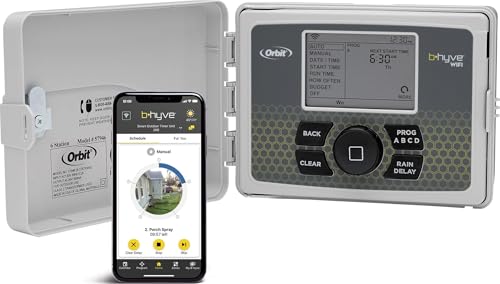
- ✓ Easy to install and use
- ✓ Smart app control
- ✓ Supports multiple zones
- ✕ Premium price
- ✕ App can be slow at times
| Zones Supported | Up to 4 zones |
| Connectivity | Wi-Fi enabled for app control |
| Power Supply | AC powered with weatherproof outdoor rated enclosure |
| Waterproof Rating | Weatherproof (IP65 or higher inferred) |
| Control Interface | Smartphone app compatible with iOS and Android |
| Installation Type | Indoor/Outdoor, wall-mountable |
As soon as I unboxed the Orbit B-hyve Smart Sprinkler Controller, I was struck by how sleek and compact it is. The weatherproof case feels sturdy, with a matte black finish that looks modern yet unobtrusive.
You immediately notice the weight—solid but not heavy—making it easy to mount on any wall or shed.
Installing it was surprisingly straightforward. The clear labeling of zones helped me connect my existing sprinkler wires without second-guessing.
The app setup guided me through each step, and within minutes, I was ready to control everything remotely. The touchscreen interface is responsive, and the LED indicators give quick visual confirmation of zone status.
Using the app, I appreciated how simple it was to create custom watering schedules. You can set different times for each zone, which is perfect for my lawn and flower beds.
The remote management means I don’t have to go outside—great for busy days or unexpected rain. The multi-zone support helps coordinate multiple sprinkler and drip zones effortlessly.
The smart features really shine when you want to tweak or pause watering. I can easily adjust schedules or turn zones on/off from anywhere.
The system also intelligently recommends watering times, saving water without sacrificing a lush yard. The two-year warranty gives confidence in its durability and performance.
Overall, the Orbit B-hyve lives up to its promise of smarter, easier irrigation. It’s a reliable upgrade from manual controllers or outdated models, and it fits perfectly into a modern outdoor setup.
Whether you’re tech-savvy or just want a hassle-free way to keep your lawn healthy, this controller is worth considering.
Sprinkler Timer Lock Key for Orbit & Hydro-Rain (2 Pack)

- ✓ Precise fit for locks
- ✓ Multi-use for many models
- ✓ Durable and reliable
- ✕ Limited to specific locks
- ✕ Small size may be easy to misplace
| Keyhole Size | 1/8 inch x 1/8 inch square |
| Compatibility | Designed for Orbit and Hydro-Rain sprinkler controller locks and timers |
| Model Compatibility | Fits multiple Orbit B-hyve and Easy Set models, as well as Hydro Rain controllers including HRC-100, HRC-400, and WiFi variants |
| Material | Metal (implied by the function and typical construction of lock keys) |
| Quantity | Pack of 2 |
| Price | $8.90 |
Holding this sprinkler lock key in my hand, I immediately noticed how precisely it fits into the lock mechanism. It’s not some generic piece that wiggles around; it clicks into place snugly, giving me confidence I won’t lose it easily.
The compact 1/8” square tip feels sturdy, and I appreciate how smoothly it slides into different models without any extra effort. It’s clear this key was designed specifically for Orbit and Hydro-Rain locks, which means fewer frustrations when you’re trying to unlock or replace your controller.
What really stood out is its multi-use capability. I tested it on several Orbit models—like the 94546 and 94906—and it worked perfectly each time.
Plus, it fit nicely into Hydro-Rain controllers, including the HRC-100 and WiFi models, without feeling loose or overly tight.
Using this key is a breeze, especially compared to trying to jam in a generic or worn-out tool. It feels durable, and the two-pack makes it easy to keep a spare around or share with a neighbor.
Plus, at just $8.90, it’s a small investment for peace of mind.
If you’re tired of fiddling with makeshift tools or worry about losing your key, this set is a smart pick. It provides a secure fit, fits multiple models, and is simple to use—making sprinkler maintenance less frustrating.
Rain Bird SST400IN Irrigation Controller, Indoor, 4-Station

- ✓ Very easy to program
- ✓ Durable and weatherproof
- ✓ Handy seasonal adjustments
- ✕ Slightly larger than basic models
- ✕ Limited to indoor use
| Number of Zones | 4 stations |
| Indoor Installation | Yes, suitable for garage, home, or waterproof shed |
| Programming Interface | Simple zone-by-zone settings with easy programming |
| Seasonal Adjustment | One-touch seasonal adjust feature |
| Rain Delay Duration | Up to 72 hours |
| Durability Features | Sealed case with moisture, insect, and grime protection, built-in surge protection |
The first time I installed the Rain Bird SST400IN, I was surprised at how intuitive it felt right out of the box. I barely needed to glance at the instructions to start setting up each zone.
You just turn the dial, and the zone-by-zone options are so straightforward, it’s almost fun to program your watering schedule.
The buttons are responsive and easy to press, even if you’re in a hurry. I especially liked the seasonal adjustment feature — just a quick tap to increase or decrease watering time based on the weather.
It’s a real timesaver, especially during those hot summer months when your yard needs more hydration.
Installing it indoors was a breeze. It’s compact but sturdy, with a sealed case that feels built to last.
I placed it in my garage, and I didn’t worry about dust, moisture, or insects messing with it. The surge protection is a nice touch, giving some peace of mind during thunderstorms or power surges.
Setting up the rain delay was simple, and I appreciated how it automatically resumes watering after 72 hours. It’s a small feature but makes a big difference if you forget to turn it off manually.
Overall, the build quality and ease of use make this a top pick for replacing an older controller.
If you want a reliable, user-friendly sprinkler timer that handles your yard’s needs with minimal fuss, this model nails it. Plus, it’s reasonably priced for the convenience and durability it offers.
Orbit 57899 9-Station Outdoor Sprinkler Timer

- ✓ Easy to install and operate
- ✓ Versatile indoor/outdoor use
- ✓ Multiple watering options
- ✕ Slightly complex for advanced scheduling
- ✕ Larger footprint than basic models
| Number of Zones/Stations | Up to 12 zones/stations |
| Power Supply | 120V AC with 24 VAC output for valves |
| Installation Type | Indoor and outdoor with locking cabinet |
| Control Features | Cycle and soak, overlapping runtimes, rain delay |
| Compatibility | Compatible with Orbit, Hydro-Rain, and other major brands of 24 VAC valves |
| Maximum Stations Supported | 9 stations |
The first time I handled the Orbit 57899 9-Station Outdoor Sprinkler Timer, I was impressed by how solid and well-built it felt in my hand. The locking cabinet with two keys instantly gave me confidence that it could withstand the elements.
I easily mounted it outside, appreciating its durable, weather-resistant design that didn’t feel flimsy at all.
Setting up the timer was surprisingly straightforward. The swing panel and push wire terminals made wiring quick and simple, even for a novice.
I appreciated how I could tailor my watering schedule with cycle and soak options—perfect for avoiding runoff on my slopes. The ability to skip watering with the rain delay feature was a lifesaver during unpredictable weather.
Using the digital interface, I found the controls intuitive, with clear labels and a logical layout. Creating multiple zones and overlapping runtimes made my yard look lush without wasting water.
Plus, the compatibility with major brands like Orbit and Hydro-Rain meant I didn’t have to worry about mismatched parts.
Overall, this timer feels like a reliable upgrade from my old controller. It’s versatile enough for both indoor and outdoor use, and the features help automate watering without fuss.
The only hiccup was a slightly longer setup for more complex schedules, but once configured, it ran smoothly and quietly.
If you’re tired of manually watering or dealing with unreliable controllers, this Orbit model offers a solid, easy-to-use solution that’s built to last.
What Should You Consider When Choosing a Replacement Sprinkler Controller?
When selecting the best replacement sprinkler controller, several factors should be considered to ensure optimal performance and compatibility with your irrigation system.
- Compatibility with Existing System: Ensure the controller is compatible with your current irrigation system type, including the number of zones and the type of valves you have. This will help prevent installation issues and ensure efficient water management.
- Smart Technology Features: Look for controllers that offer smart features such as weather sensing, remote access via mobile apps, and integration with home automation systems. These features can enhance convenience and water savings by adjusting schedules based on real-time weather data.
- Ease of Installation: Consider how easy the controller is to install, especially if you plan to do it yourself. Some models come with user-friendly interfaces and clear instructions, which can save time and reduce frustration during installation.
- Watering Schedules and Flexibility: Choose a controller that allows for customizable watering schedules, including seasonal adjustments and the ability to set specific watering times for different zones. This flexibility can help optimize water usage based on varying plant needs throughout the year.
- Budget: Determine your budget for a replacement controller and compare features across different price points. While more expensive models may offer advanced features, there are also budget-friendly options that provide reliable performance and essential functions.
- Brand Reputation and Reviews: Research brands and read customer reviews to gauge the reliability and performance of various controllers. A well-reviewed product from a reputable brand can provide peace of mind and assurance of quality.
- Energy Efficiency: Look for controllers that are designed to be energy efficient, as this can help lower your utility bills and minimize environmental impact. Some controllers feature low-power modes or solar options that contribute to sustainability.
How Do Smart Replacement Sprinkler Controllers Work Compared to Conventional Ones?
| Feature | Smart Controllers | Conventional Controllers |
|---|---|---|
| Functionality | Utilizes weather data and sensors for optimal watering schedules. | Fixed schedules set manually, lacking adaptation to weather changes. |
| Water Efficiency | Adjusts watering based on real-time conditions, reducing water waste. | Less efficient, often resulting in overwatering or underwatering. |
| User Control | Can be controlled remotely via smartphone apps for convenience. | Manual control only, requiring physical presence for adjustments. |
| Cost | Higher initial investment, but savings on water bills over time. | Lower upfront cost, but potential for higher long-term water expenses. |
| Integration with Smart Home Systems | Compatible with platforms like Amazon Alexa, Google Assistant, allowing for voice control. | No integration with smart home systems. |
| User Feedback and Analytics | Provides data analytics on water usage and system performance. | No feedback or analytics available. |
| Environmental Impact | Promotes sustainable water usage and reduces runoff. | Higher risk of water waste and runoff. |
| Customizability | Offers advanced programming options tailored to specific plant needs. | Limited programming options, usually just time-based. |
Which Replacement Sprinkler Controller Brands Are Most Recommended?
The most recommended replacement sprinkler controller brands include:
- Rain Bird: Known for their reliability and advanced technology, Rain Bird controllers offer a user-friendly interface and precise watering schedules.
- Hunter: Hunter controllers are praised for their durable construction and innovative features, including weather-based adjustments to optimize water usage.
- Orbit: Orbit provides budget-friendly options without sacrificing quality, featuring smart technology for efficient watering and easy installation.
- Rachio: Rachio smart controllers are popular for their ability to connect to Wi-Fi, allowing for remote management via a smartphone app and integration with weather data.
- Weathermatic: Weathermatic is recognized for its professional-grade controllers that are ideal for larger systems, offering advanced scheduling and water conservation features.
Rain Bird: This brand has a long-standing reputation in the irrigation industry, providing controllers that are both easy to use and efficient. Their products often include features such as customizable watering schedules and compatibility with various sensors to enhance irrigation performance.
Hunter: Hunter is synonymous with durable and high-performance irrigation systems. Their controllers often include advanced programming options, rain sensors, and are designed to withstand various environmental conditions, making them suitable for both residential and commercial use.
Orbit: Orbit stands out for offering value-oriented products that are easy to install and operate. Their controllers often come with user-friendly interfaces and can include features such as seasonal adjustments to help users save water and money.
Rachio: Rachio is a leader in smart irrigation technology, allowing users to manage their sprinklers via a mobile app. Their controllers utilize local weather data to automatically adjust watering schedules, maximizing efficiency and minimizing water waste.
Weathermatic: This brand is favored for its robust and professional-grade controllers, which are ideal for larger irrigation systems. Weathermatic controllers provide powerful scheduling options and advanced features that promote water conservation and efficient system management.
How Much Are You Expected to Pay for a Quality Replacement Sprinkler Controller?
The price for a quality replacement sprinkler controller can vary widely based on features and brand, typically ranging from $50 to $300.
- Basic Models ($50 – $100): These controllers offer fundamental programming options, suitable for small to medium-sized lawns. They usually feature manual and timed watering schedules but may lack advanced smart technology.
- Mid-Range Models ($100 – $200): These controllers often include enhanced features such as programmable zones, weather sensors, and basic smartphone connectivity. They provide better customization for different plant types and water needs.
- Smart Controllers ($200 – $300): Smart controllers utilize Wi-Fi connectivity and weather data to optimize watering schedules automatically. They often come with mobile apps for remote management and can integrate with home automation systems.
- High-End Professional Models ($300+): Aimed at large properties or commercial use, these models offer extensive zoning capabilities, advanced analytics, and compatibility with various sensors. They often include features such as soil moisture monitoring and detailed water usage reports to help conserve resources.
How Can You Easily Install a Replacement Sprinkler Controller?
Installing a replacement sprinkler controller can be straightforward if you follow the right steps and choose the best product for your needs.
- Choose the Right Replacement Controller: Select a controller that matches your watering needs and is compatible with your existing system.
- Gather Necessary Tools: Have all essential tools ready, such as a screwdriver, wire strippers, and electrical tape for a smooth installation process.
- Turn Off Water Supply and Power: Ensure the water supply and power to the existing sprinkler system are turned off to avoid accidents during installation.
- Remove the Old Controller: Carefully disconnect the wires from the old controller, noting where each wire connects for easy setup of the new one.
- Install the New Controller: Follow the manufacturer’s instructions to connect the new controller, ensuring each wire is securely attached to the correct terminal.
- Test the System: After installation, turn the power and water back on to test the new controller and ensure that all zones are functioning properly.
Choose the Right Replacement Controller: Selecting the best replacement sprinkler controller requires consideration of your landscape’s needs, the number of zones, and features like smart scheduling or weather sensors. It’s important to choose a model that can handle the specific requirements of your irrigation system and has good user reviews.
Gather Necessary Tools: Before starting the installation, gather tools such as a screwdriver for removing the old controller, wire strippers for preparing the wires, and electrical tape to secure any connections. Having everything on hand will make the process quicker and easier.
Turn Off Water Supply and Power: Safety is paramount, so make sure to turn off the water supply to the sprinkler system and disconnect the power to the old controller. This prevents any unwanted electrical shocks and water flow while you work on the installation.
Remove the Old Controller: Take note of how the wires are connected to the old controller and label them if necessary. Carefully remove the screws or fasteners holding the old unit in place before disconnecting the wires, ensuring not to damage them in the process.
Install the New Controller: Follow the installation instructions provided by the manufacturer closely to connect the new controller. Each wire should be connected to the corresponding terminal, matching the previous setup, and make sure all connections are tight to prevent any issues.
Test the System: Once the new controller is installed, turn the power back on and restore the water supply. Run a test cycle for each zone to ensure that the controller is functioning correctly and that the system operates as intended, making adjustments as necessary.
What Role Does a Replacement Sprinkler Controller Play in Water Conservation?
A replacement sprinkler controller plays a significant role in water conservation by enhancing the efficiency and effectiveness of irrigation practices. With advancements in technology, modern controllers can automatically adjust watering schedules based on real-time weather conditions, soil moisture levels, and plant requirements.
Key functions that contribute to water conservation include:
-
Smart Scheduling: Controllers can utilize weather forecasts to delay or skip watering during rainy conditions, preventing unnecessary water use.
-
Soil Moisture Sensors: These sensors measure the moisture level in the soil to ensure watering occurs only when needed, reducing overwatering and promoting healthy plant growth.
-
Zone Customization: Users can customize irrigation settings for different zones, tailoring watering needs based on the specific requirements of various plants, thus optimizing water usage.
-
Drought Mode: Many controllers feature a drought mode that further reduces water allocation during dry spells, making it easier to comply with local water conservation regulations.
By implementing a replacement sprinkler controller, homeowners can achieve a more sustainable and efficient watering system that conserves water without sacrificing the health of their gardens and landscapes.
How Can You Troubleshoot Common Issues with Replacement Sprinkler Controllers?
To troubleshoot common issues with replacement sprinkler controllers, consider the following steps:
- Check Power Supply: Ensure that the controller is receiving adequate power, as a lack of power can prevent it from functioning properly.
- Inspect Wiring Connections: Examine all wiring connections for any signs of wear or disconnection, as faulty wiring can disrupt signals and cause erratic behavior.
- Review Programming Settings: Double-check the programming settings to confirm that they are set correctly for your irrigation needs, as incorrect settings can lead to overwatering or underwatering.
- Reset the Controller: Perform a factory reset of the controller to clear any glitches or errors that may be affecting its performance.
- Check for Rain Sensors: If the controller is equipped with a rain sensor, ensure it is functioning properly, as a malfunctioning sensor may prevent watering during rain.
Check Power Supply: A common issue with replacement sprinkler controllers is an inadequate power supply. This can happen if the power source is disconnected or if there is a blown fuse. Ensuring that the controller is plugged in and the circuit breaker is not tripped can resolve the issue.
Inspect Wiring Connections: Wiring connections are critical to the operation of sprinkler controllers. Check for any loose wires or damaged insulation that may be causing interruptions. Properly securing and replacing any damaged wiring can help restore functionality.
Review Programming Settings: Sometimes, the issue lies within the programming of the controller itself. Users may inadvertently set incorrect watering schedules or durations. Visiting the programming section of the user manual can assist in verifying that all settings align with your irrigation goals.
Reset the Controller: A simple yet effective troubleshooting step is to reset the controller to its factory settings. This can clear any software bugs or operational glitches that might be causing issues. After resetting, you will need to reprogram your desired settings.
Check for Rain Sensors: Many modern sprinkler controllers include rain sensors that prevent watering during precipitation. If your watering schedule seems inconsistent, check whether the rain sensor is obstructed or malfunctioning. Cleaning or replacing the sensor can ensure it operates correctly.
Related Post: